
The Inflector, the Municipath Dare, part three (16:04). Sue opens and closes it, the Corridor Anchor presents, and Roger Rodger is the operator. The voices are synthetic. The design is a design: nothing in it is built.
The first part of the Municipath Dare walked the proof of concept. The second walked Interstate 4 with an AI anchor working the app’s own screens. This one goes under the road.
It starts with the reflectors on the lane lines. They have always just reflected. The film asks what happens if some of them can feel the road, and then walks a proposed answer, in the app, in 3D (0:33).
The Inflector
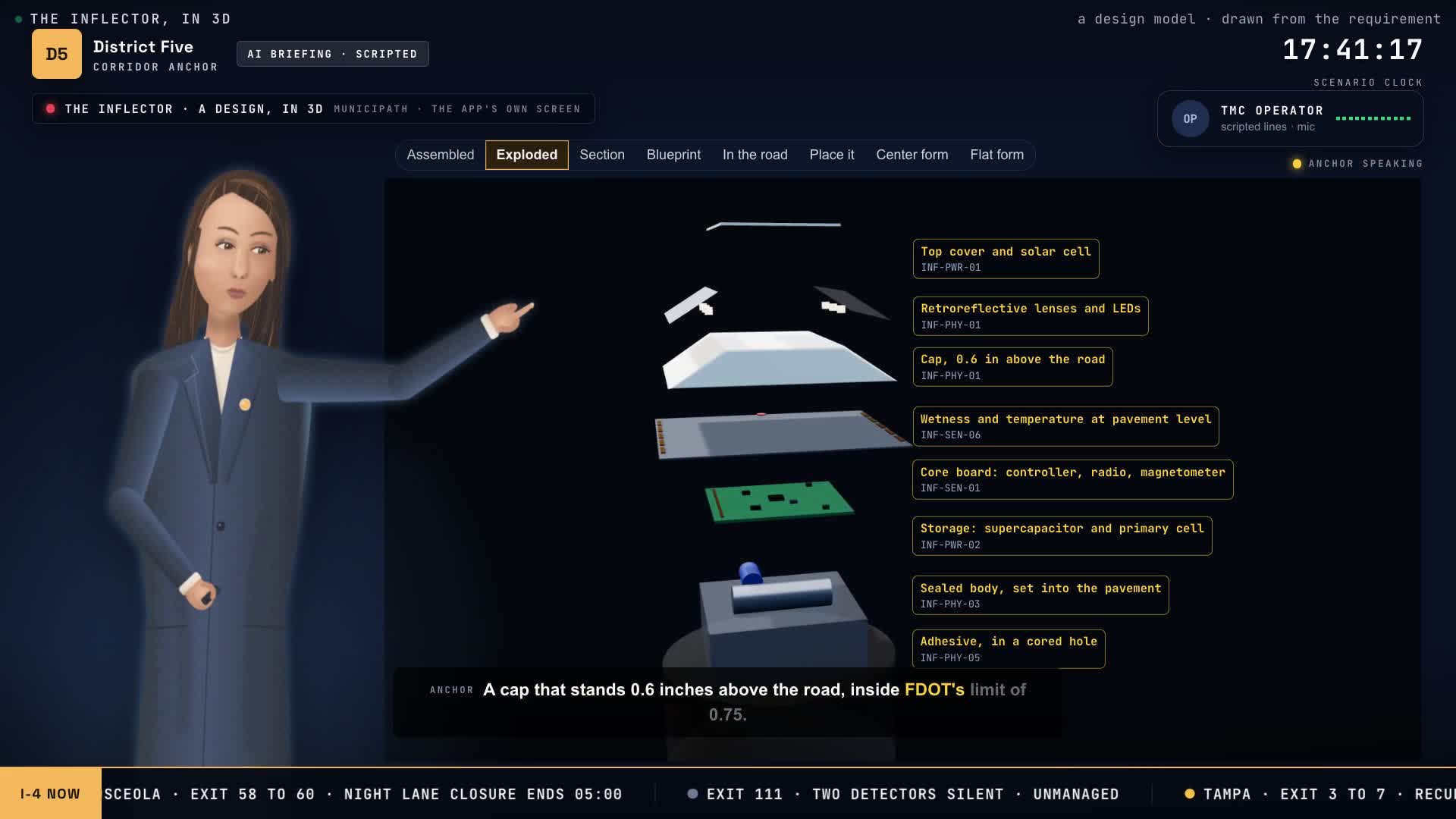
We call it the Inflector: an environment aware mesh detection reflector. It is a standard road reflector that feels the road where it sits, times every vehicle that passes, and joins its segment by itself. In the film the model comes apart layer by layer, each part labelled with the requirement it answers (1:08).
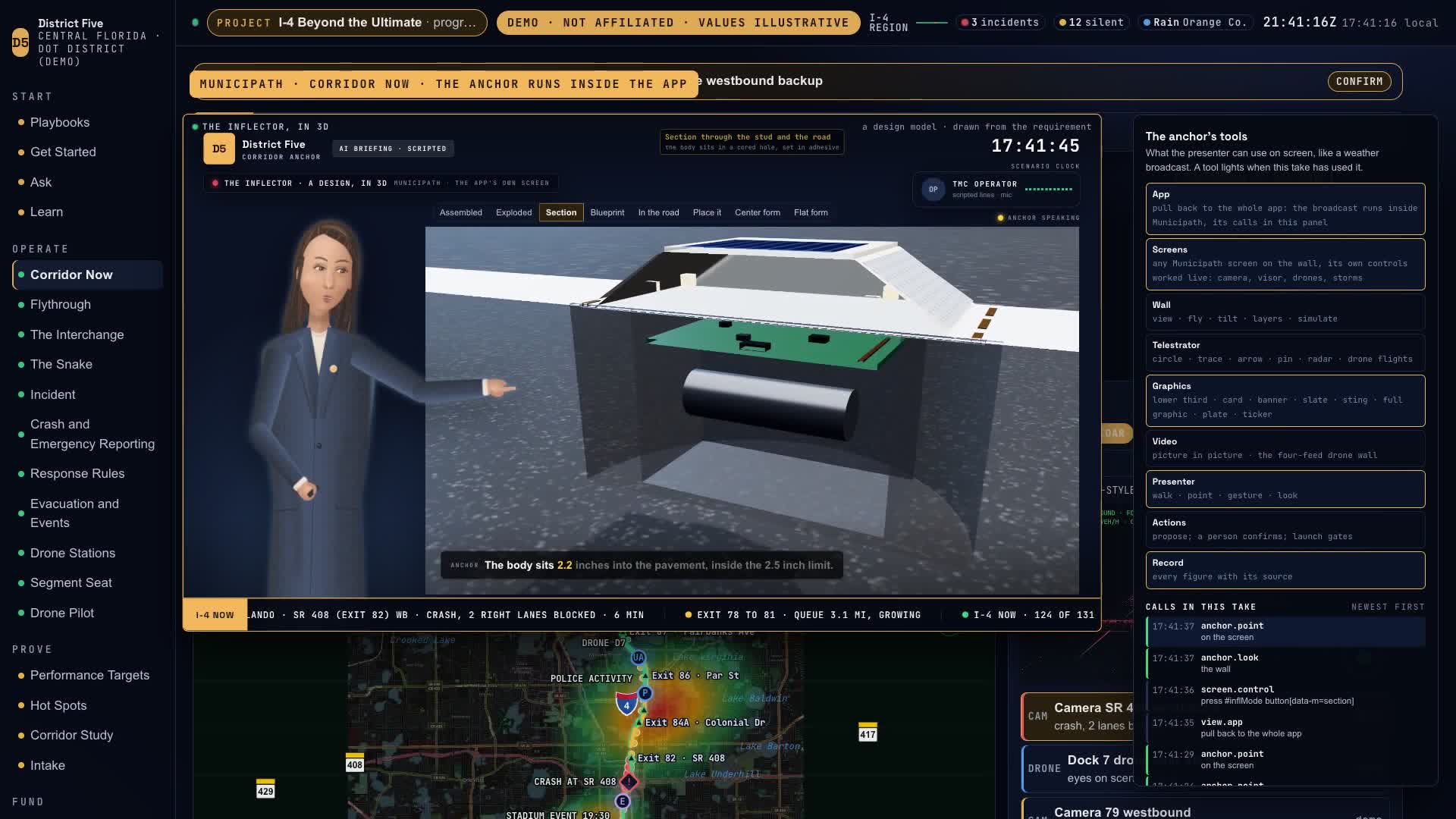
The cutaway shows how it stays small above the road and still holds a battery. The cap stands 0.6 inches up, inside FDOT’s limit of 0.75, and the body sits 2.2 inches into the pavement, inside the 2.5 inch limit (1:40). The blueprint puts each dimension against its limit (2:00).
It is meant to be as close to indestructible as we can make it: wheel loads to the 20,000 pound single axle limit, sealed to IP68. Those are targets, and the laboratory tests will say how close it comes.
The energy is the hard part, so the film shows it in numbers from the datasheets (3:25). Sensing and reporting take about 44 joules a day. One small cell in an Orlando December gives about 343 in ideal conditions. A radio receiver left listening would cost 1,804 joules a day, so the mesh is scheduled. With no sun at all, a 2.6 amp hour cell lasts about two years.
Of the five must-haves, speed is a proven method, temperature and wetness are proven in flush sensors and still to prove in a stud, the mesh radios exist with the design still open, and a battery that lasts is partly proven. We searched what others sell. Every road stud we found only lights up.
Place it, and it joins the hive
Placing one takes a cored hole and adhesive. It is set as every Xth reflector in the normal replacement, and it joins by itself: identity sealed in at the factory, a signed voucher at the segment hub, then new and unconfirmed until a person confirms it on the segment’s seat. A Flyby, a drawing labelled as one, walks the pairing step by step (4:41).
The hive and its drone station
Each segment’s hub is its drone station, a concept described from the requirement: a mast with the weather station on top and the roadside radio at 8 metres, the FCC’s height for full power; a sealed dock; edge compute with 72 hours of buffer; two backhaul paths. The film launches a drone, charges it, holds it for gusts, and services the station with one module out (5:24).
The research changed one line we wanted to say. FAA waivers name the dock and the aircraft together, so a hub takes approved pairs, not any drone in any dock (6:26).
Setting up a hive is a plan Municipath lays out from the inputs on screen. Twelve miles, two segments, four lanes each way and an Inflector every fourth reflector come to 2,376 Inflectors, if the reflectors are 40 feet apart, which is an assumption to check (6:53). Piloting two segments anywhere takes six steps, and the last is ours: Municipath runs the study and prepares the funding items from the evidence it collected.
A traffic cop for every segment
A segment governs itself, inside limits. It senses, its approved model proposes, a person confirms, it acts within today’s rules, and every step is recorded. If the backbone is unreachable it keeps its last approved model and says LOCAL. Nothing changes the road on its own (8:10).

The film is plain about light. Today’s rules allow steady light in the marking’s colour. A taper of light that closes a lane, and active red for a wrong-way driver, would need an FHWA experiment that FDOT requests (9:07). Reading direction for a wrong-way driver needs nothing new: the magnetometer pairs already read it (9:45). When studs are lost, the gap is shown as a gap, and a repair ticket opens by itself (10:13).
One pilot, several drones
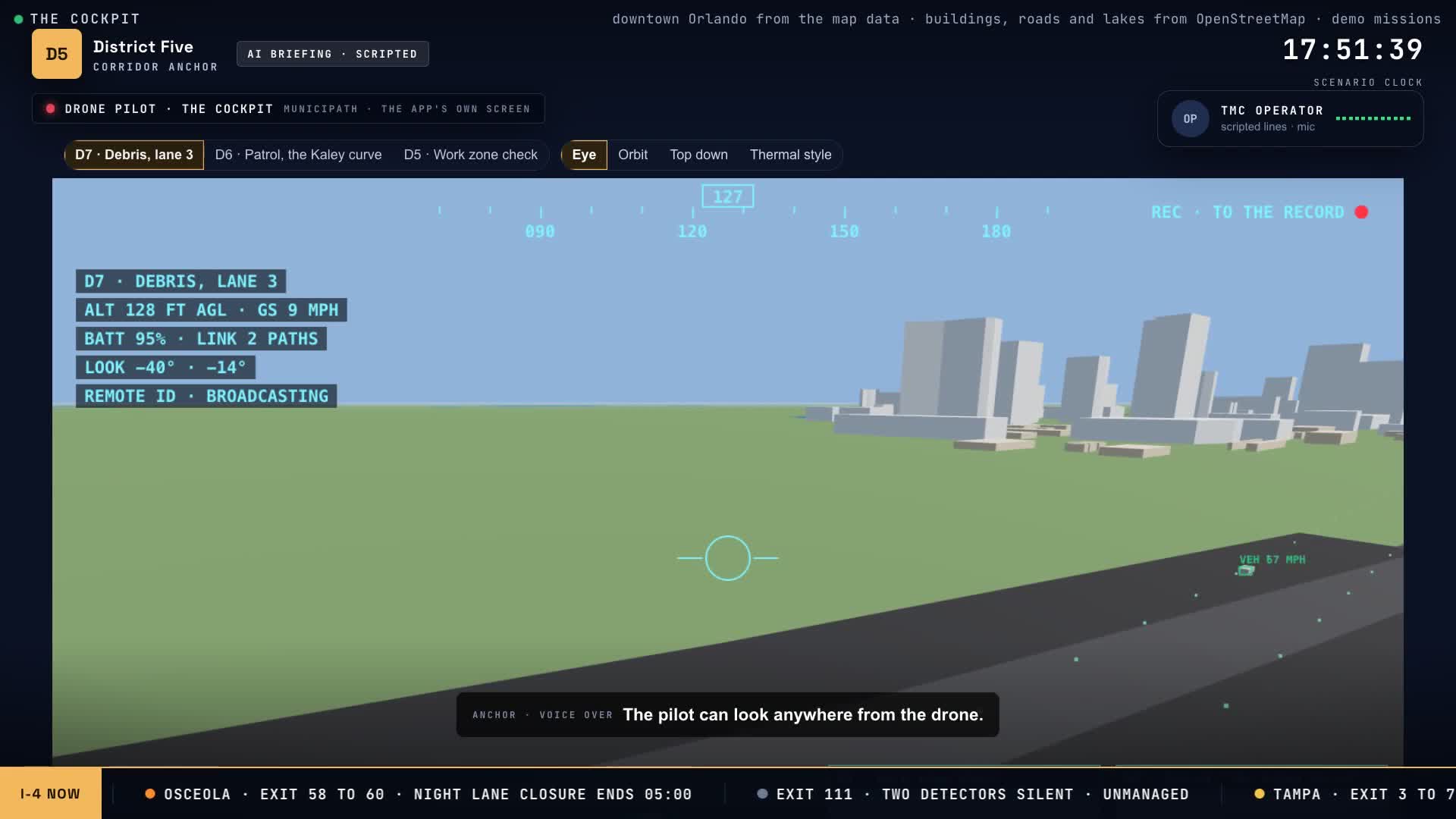
The Drone Pilot cockpit flies three missions at once over downtown Orlando, built from the map data’s real footprints and heights. The pilot looks anywhere from a drone, asks the assistant to turn to lane 3, and switches between missions. Today one pilot flying several drones needs an FAA waiver: the FAA lists 281 of them, with limits like four aircraft per pilot (11:26).
Sooner than a fleet of autopilots
There are 289 million vehicles on American roads, 12.8 years old on average, by S&P Global Mobility’s count. Even if every new car sold were self-driving, at 16 million a year it would take about 18 years to turn the fleet over. A road that tells every car, old or new, can help sooner. It advises; the vehicle decides (12:30).
Under the road
The last part shows what the first two films stood on. A state is set up once from its own sources of truth: Florida’s pack of 31, each with its date, and the statutes, each cited. Every event after that is signed, validated, ordered and deduplicated, and one that fails is shown unmanaged, never filled in (13:10). Then the flow lights up, from the sources through the twin to everything the corridor walk showed (14:43).
What is real, and what is not yet
- The Inflector, the segment hive, the drone station and the Drone Pilot are designs. None is built.
- Every figure about the design comes from its requirement, and the requirement lists its open questions for the engineers who will answer them.
- Light beyond steady light in the marking colour is a proposal that needs an FHWA experiment.
- The Flybys are drawings, labelled as drawings. The screens are Municipath’s proof of concept.
- The rates in the data flow are the proof of concept’s, and District Five is a demo district.