
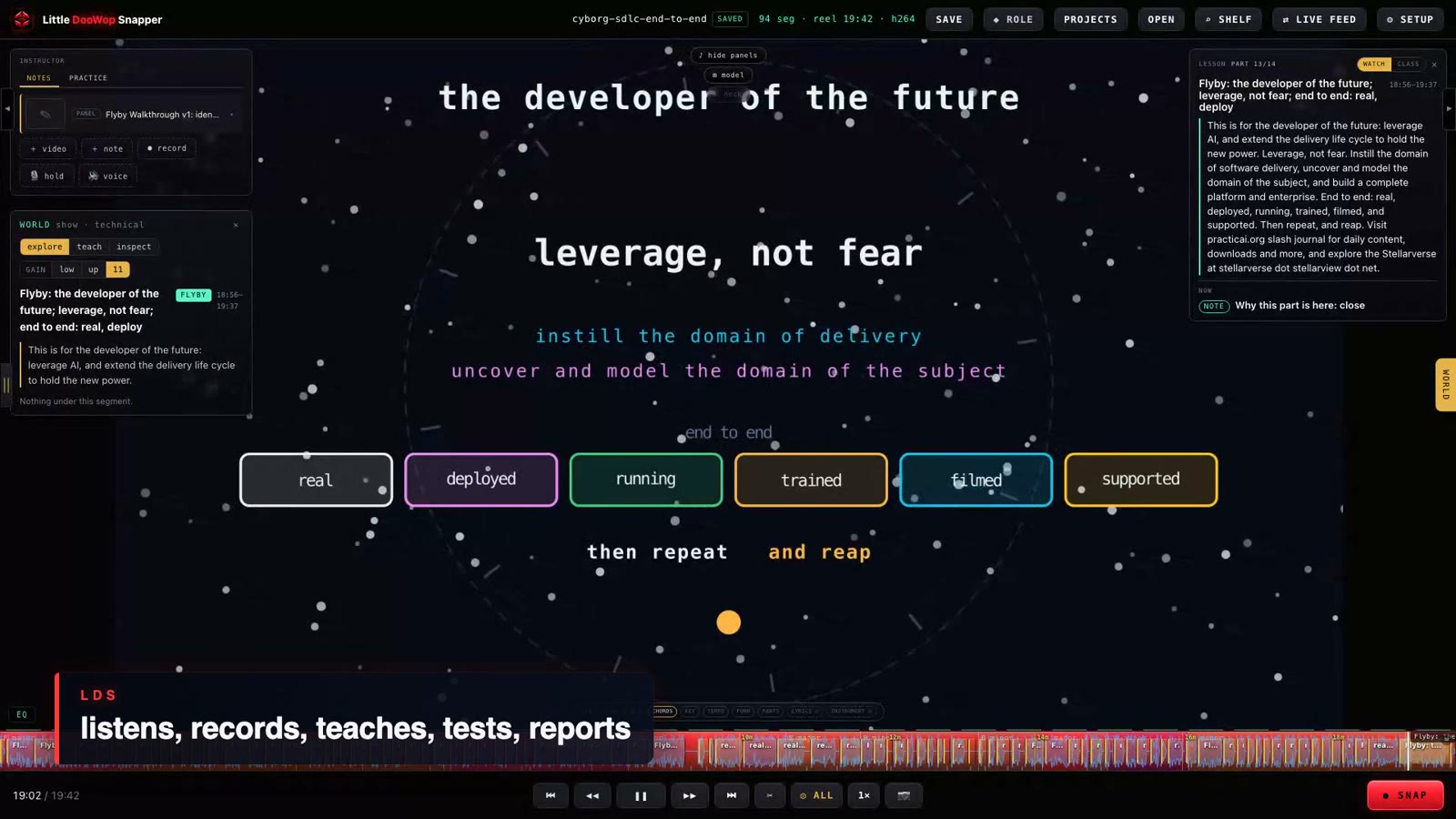
It listens, records, teaches, tests, reports
Part two of Every claim cites a fact. Part one was nineteen minutes of the whole delivery lifecycle on real screens. This is what sits under it: the model the film wrote while it was being made, opened in our Learning Design Studio and walked, stop by stop, in three and a half minutes.
Under the film (3:27). Our nineteen-minute film playing in the Learning Design Studio, and the model under it, walked stop by stop: it listens, records, teaches, tests and reports.
A meeting usually leaves behind a recording nobody watches and notes nobody trusts. One of our sprint meetings leaves behind a model. In it, every line is kept with who said it and when, every claim with the facts it rests on, and every fact with the snapshot it was frozen in and the system it was read from. The terms it used are defined. There is a path for learning it, a test you can take, and a report the model writes about itself without calling a model. The meeting is also closed against what we meant to arrive with. And the whole thing is in Spanish.
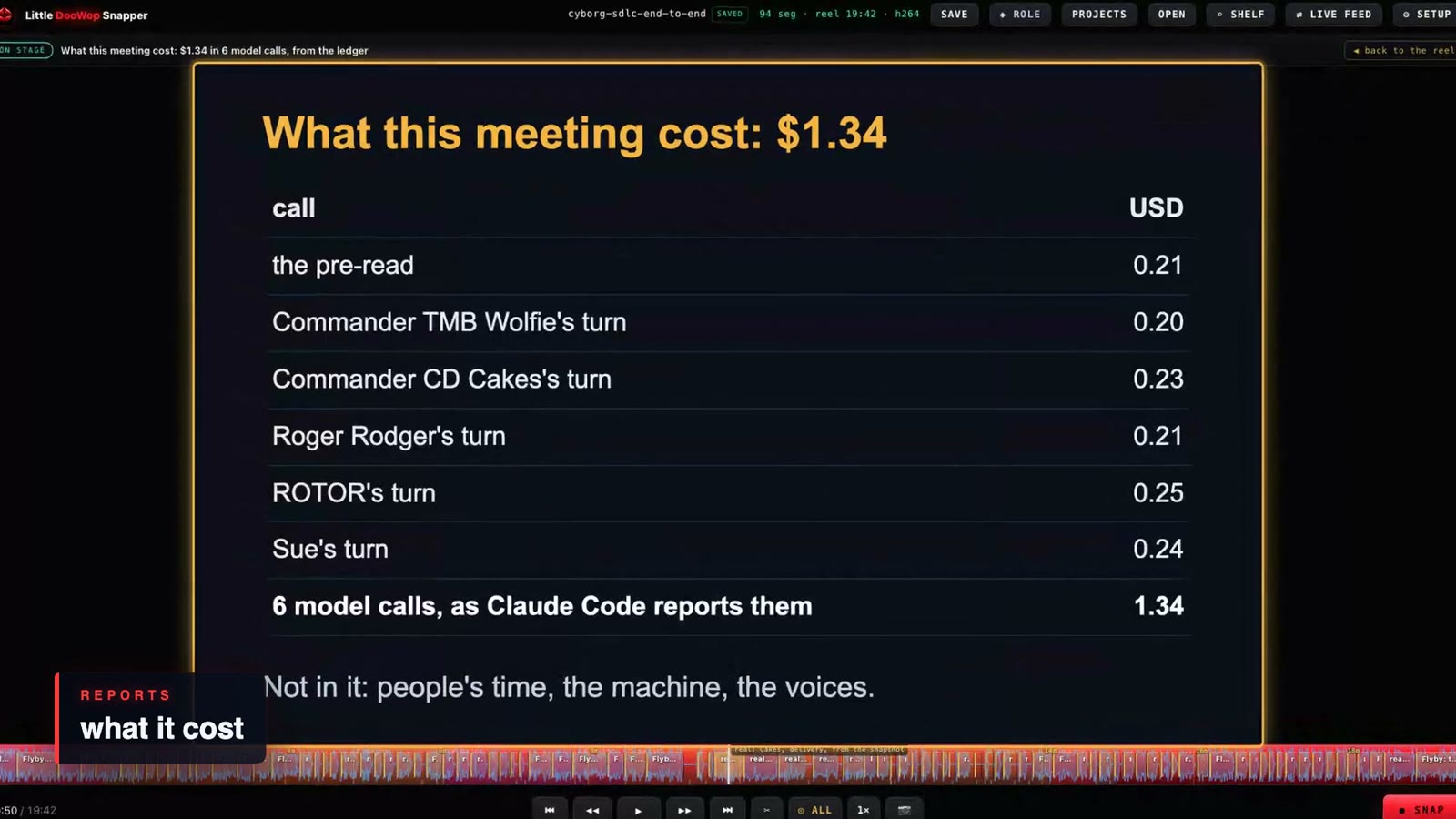
This is the refinement from part one: five agent seats and one person, $1.34 in model calls. The film below walks what that one meeting left behind.
Watch it (3:27) · What the model holds · What does not work yet
What the model holds
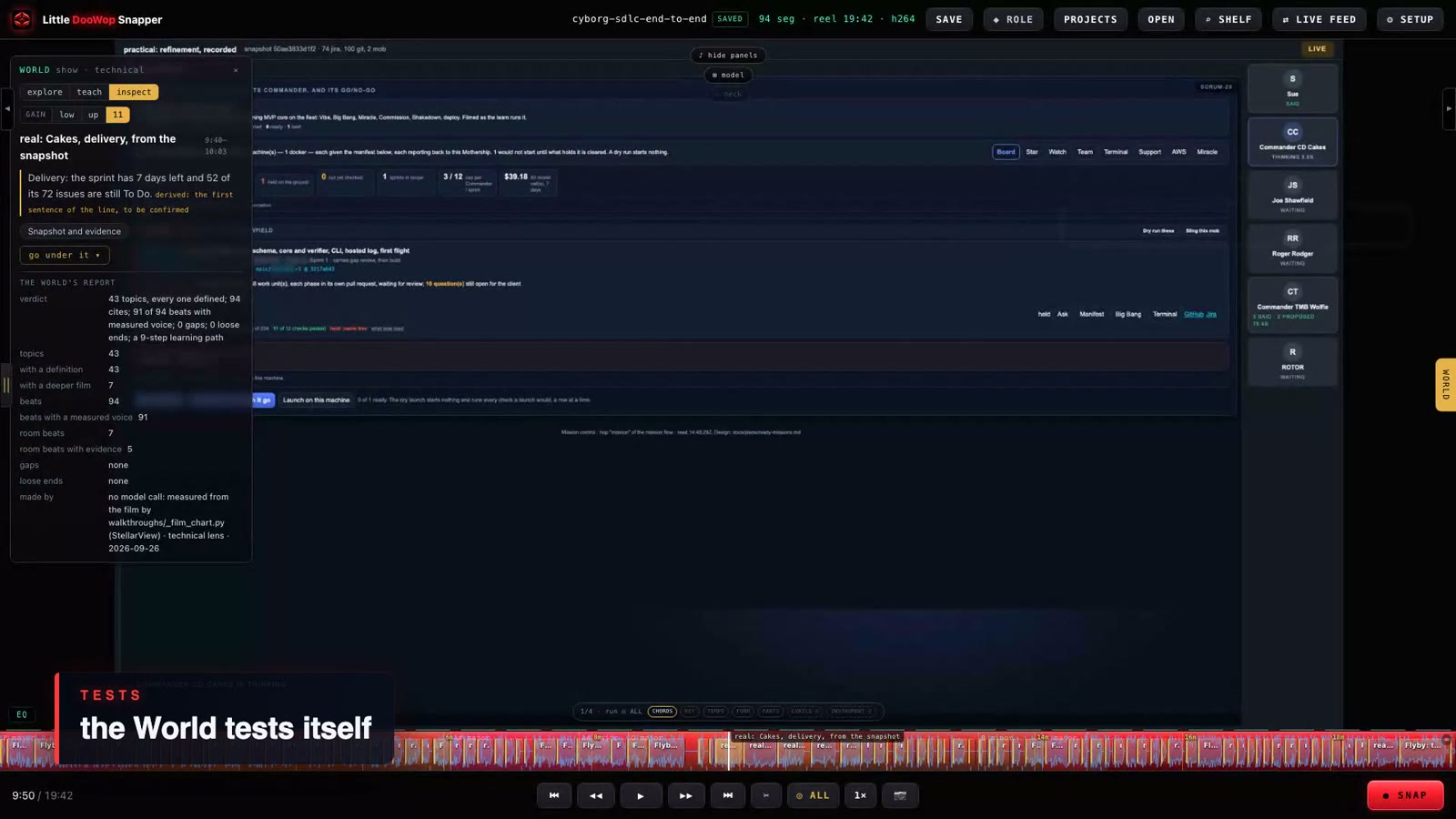
These are counted by the model’s own report, _film_chart.py in StellarView, measured from the
film with no model call.
| Beats: every line, its voice, its moment | 94 (91 with a measured voice) |
| Topics taught, every one defined | 43 |
| Cited facts, each with its source and when it was taken | 94 |
| Topics with a deeper film behind them | 7 |
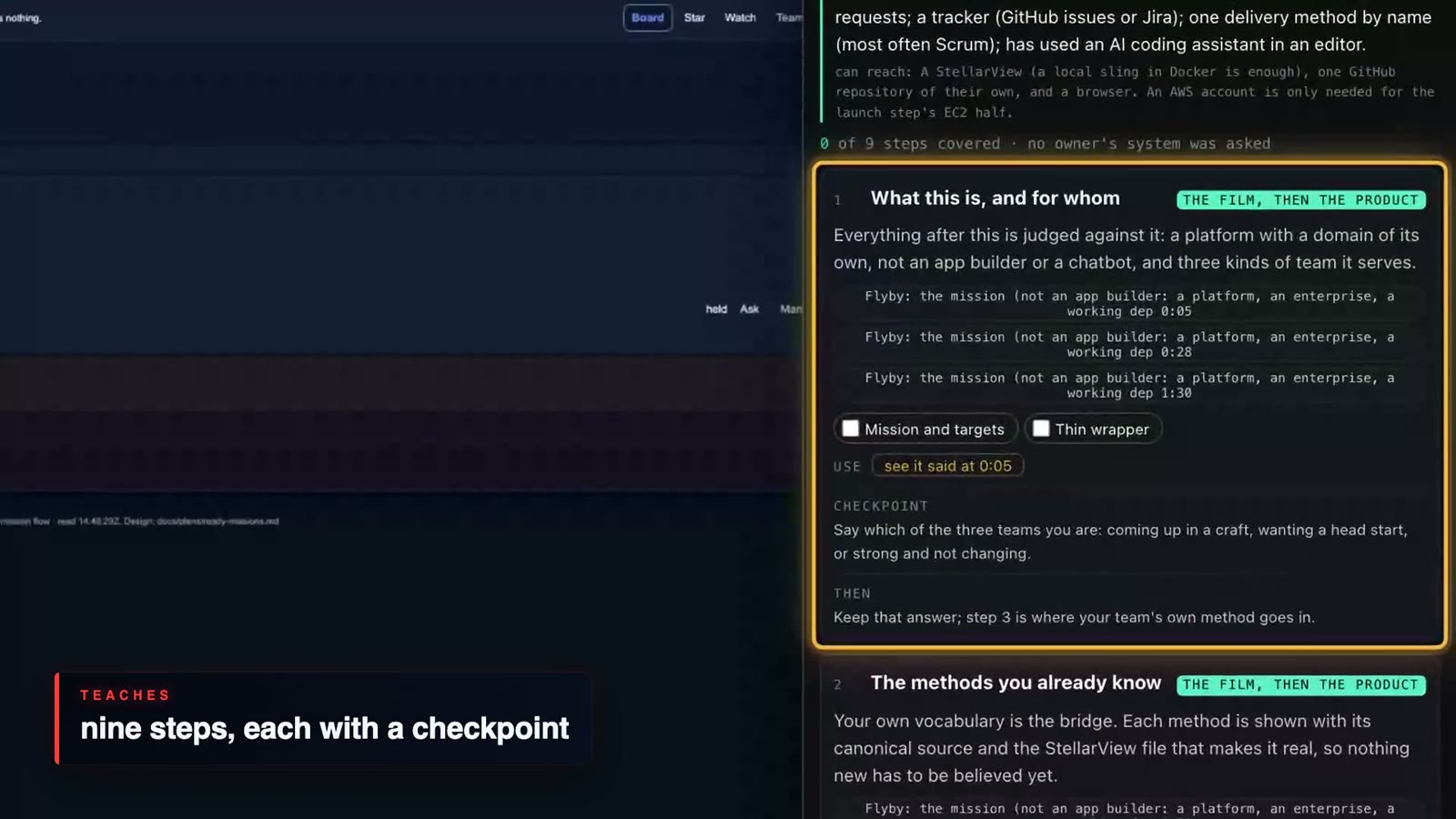
| Learning path, for a stated viewer | 9 steps, each with a checkpoint |
| Gaps, loose ends | 0, 0 |
| Spanish pack, each string tied to its English | 2,076 strings |
| What the meeting cost | $1.34, six model calls |
It listens
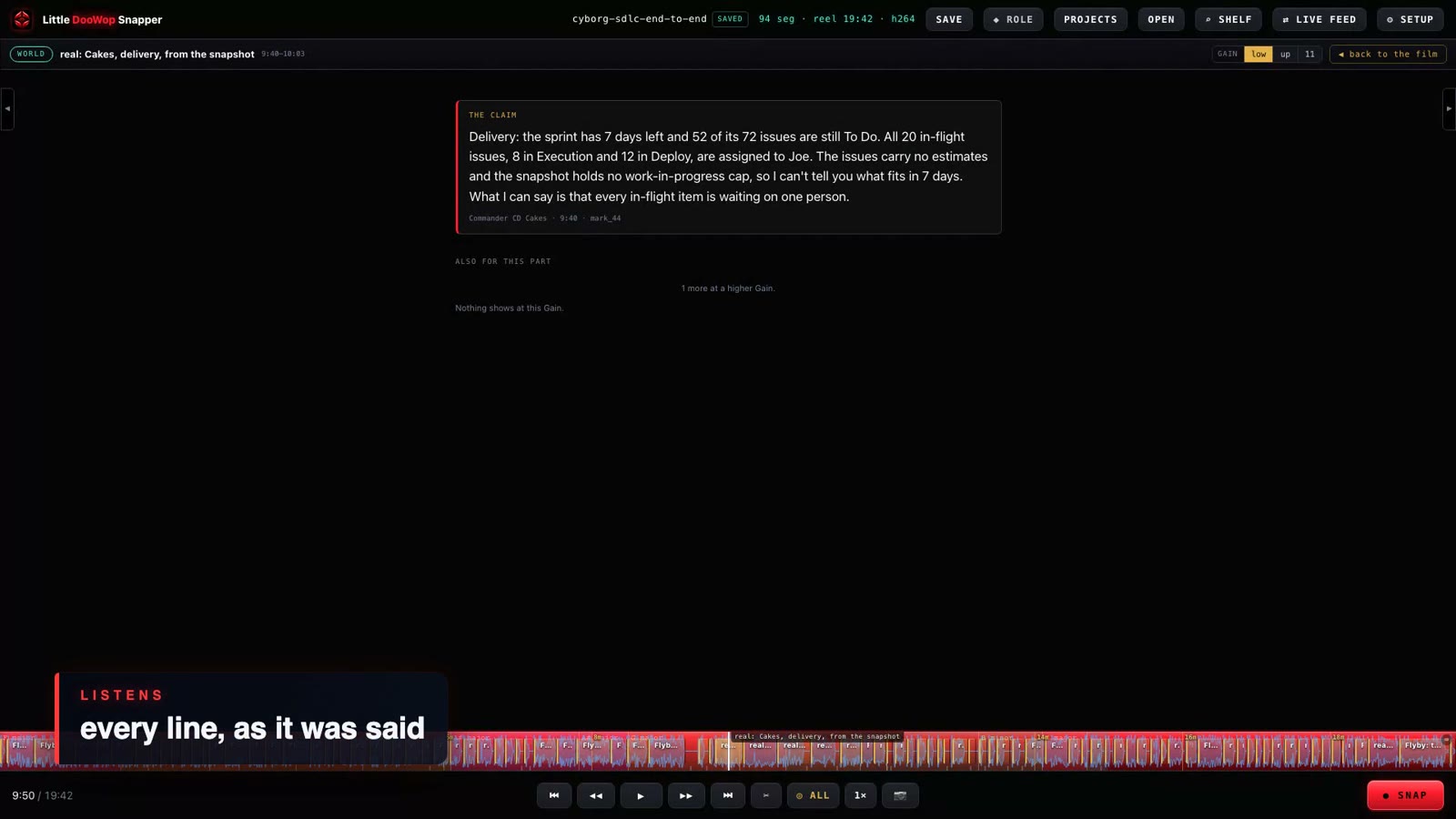
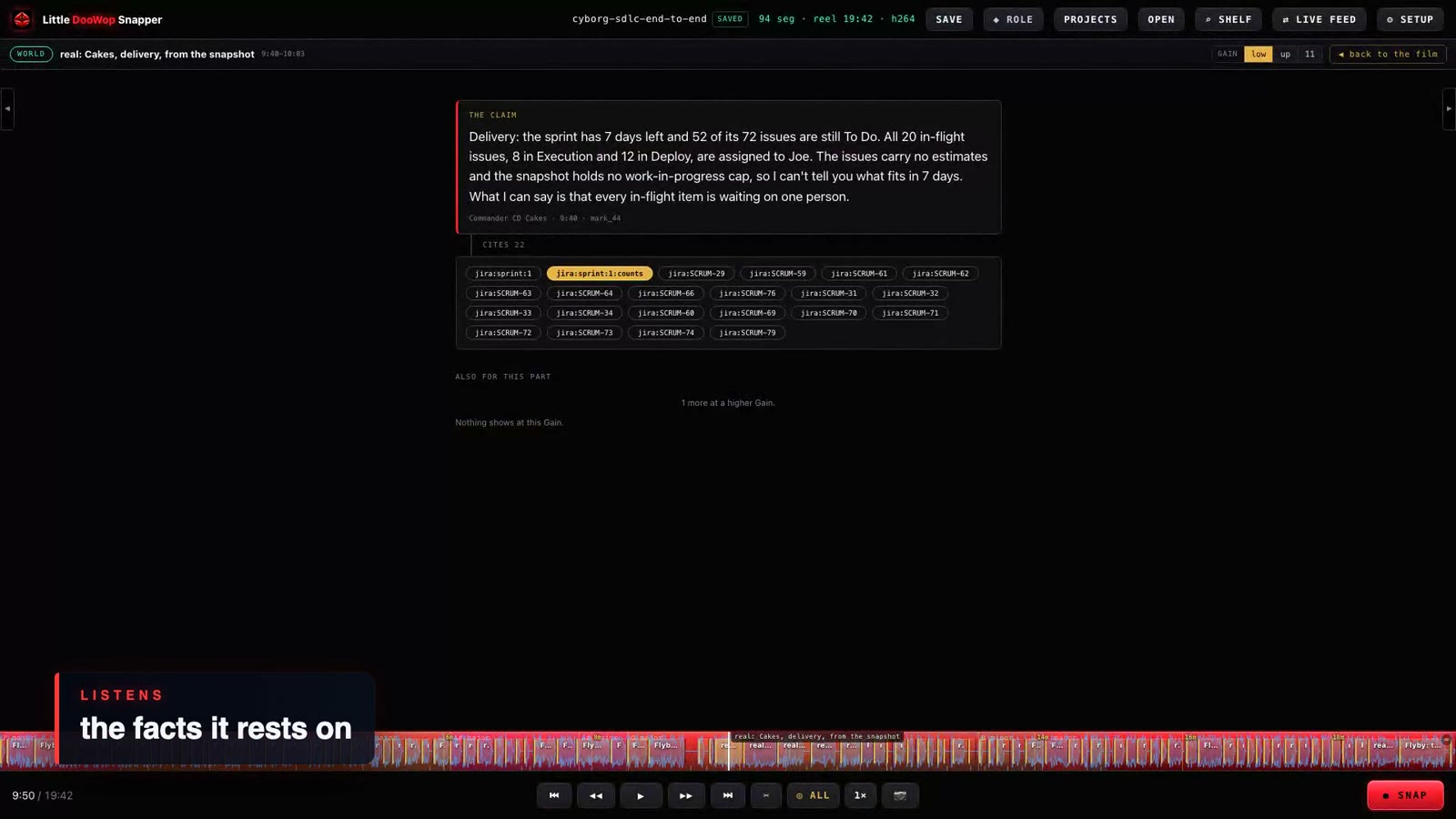
Every line is kept as it was said, with who said it and when. At 0:21 it is Cakes, one of the agent seats, in the real refinement, at 9:40 in the long film. Beside the line are the facts it rests on: twenty-two of them, each with its own id. That is the rule from part one made visible. An agent’s claim that cites no fact, or an id that is not in the snapshot, is struck before it is said.
It records
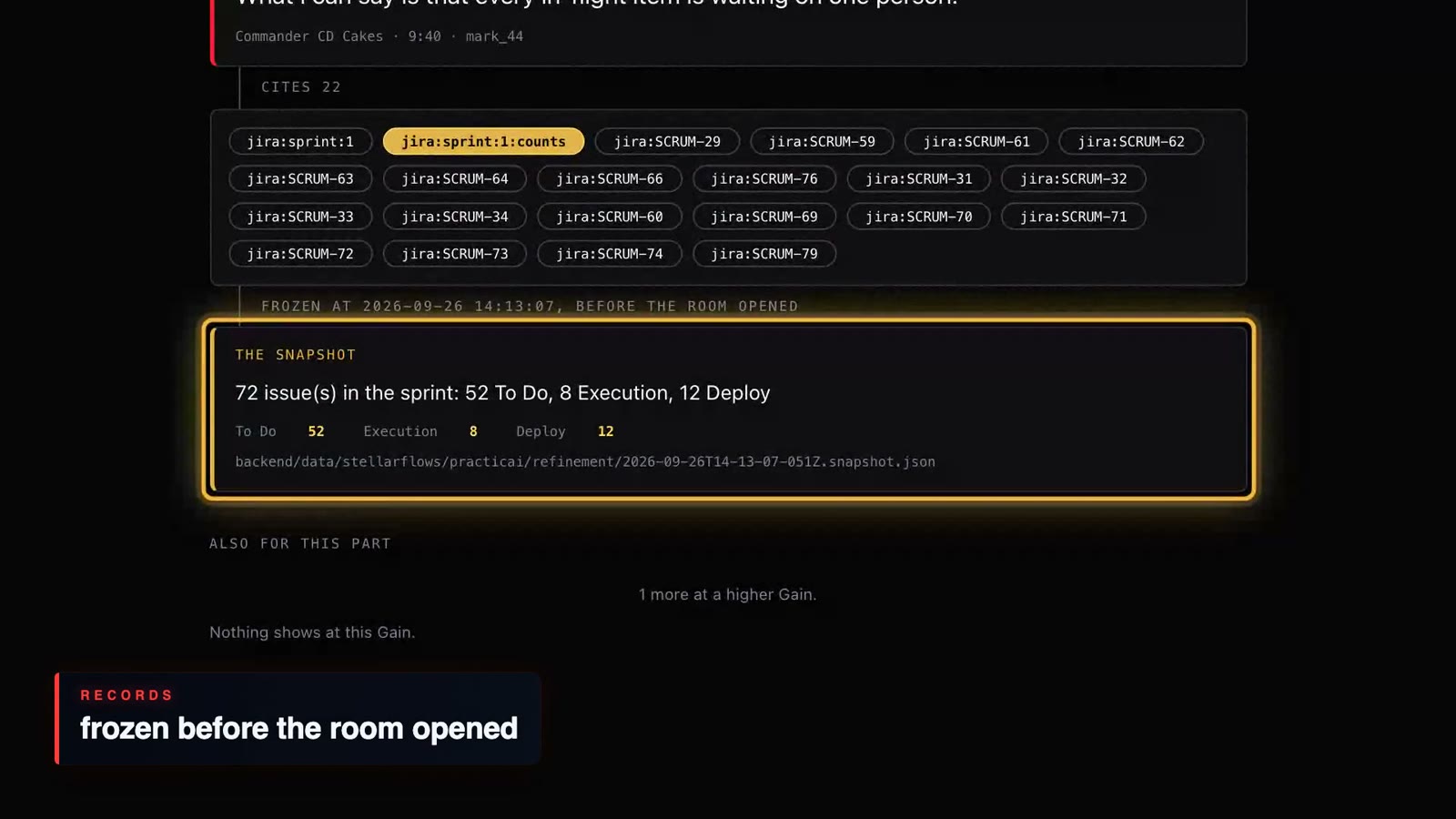
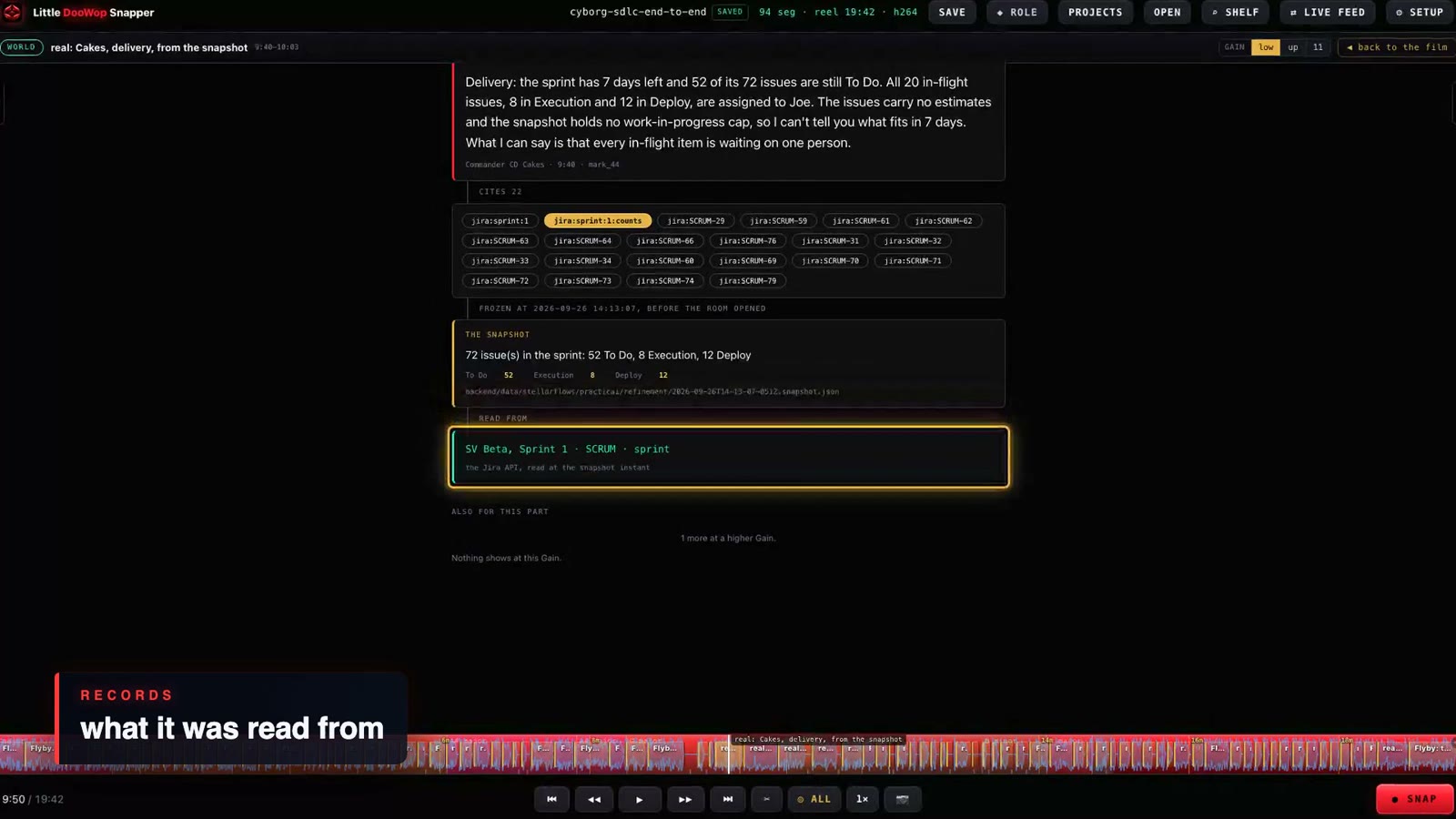
Open one fact and you get what it said and when it was frozen: at 14:13 UTC on 26 September, before the room opened, 72 issues in the sprint, 52 To Do, 8 in Execution, 12 in Deploy. You also get the snapshot file it lives in and where it came from: the sprint itself, read through the Jira API at that instant (0:37). Nobody wrote that number down. The meeting read it, and the model kept the receipt.
It teaches
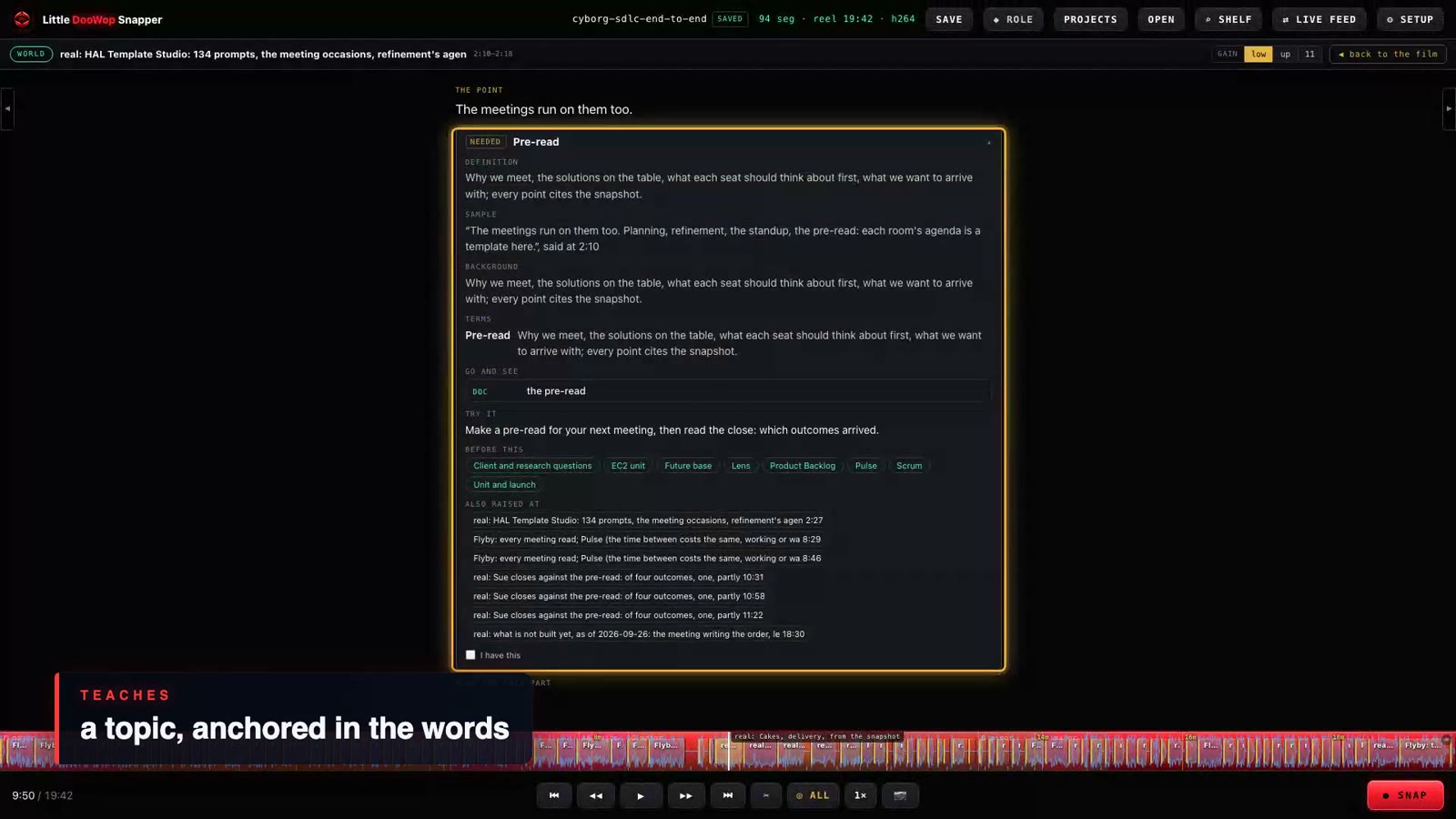
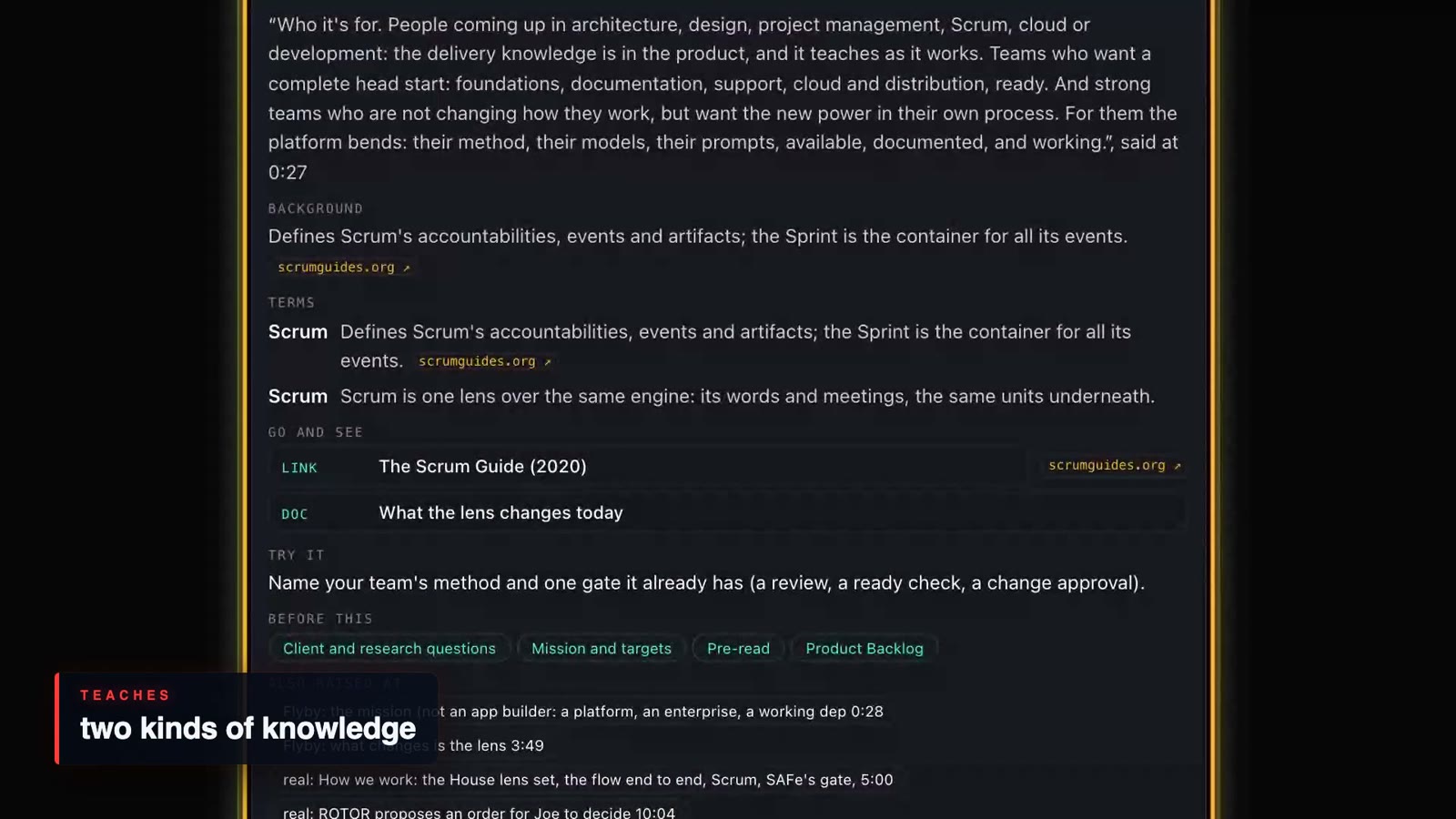
Every topic is anchored in the words that said it. Open the pre-read and you get what it is, the line in the film where it is said, and something to try. Under that is what to know first, and each of those opens its own card (1:00). A method such as Scrum is shown twice, side by side: from its canonical source (the Scrum Guide) and from the StellarView file that makes it real. That pairing is the point. The general knowledge and the house’s own knowledge are kept together, and each is cited.
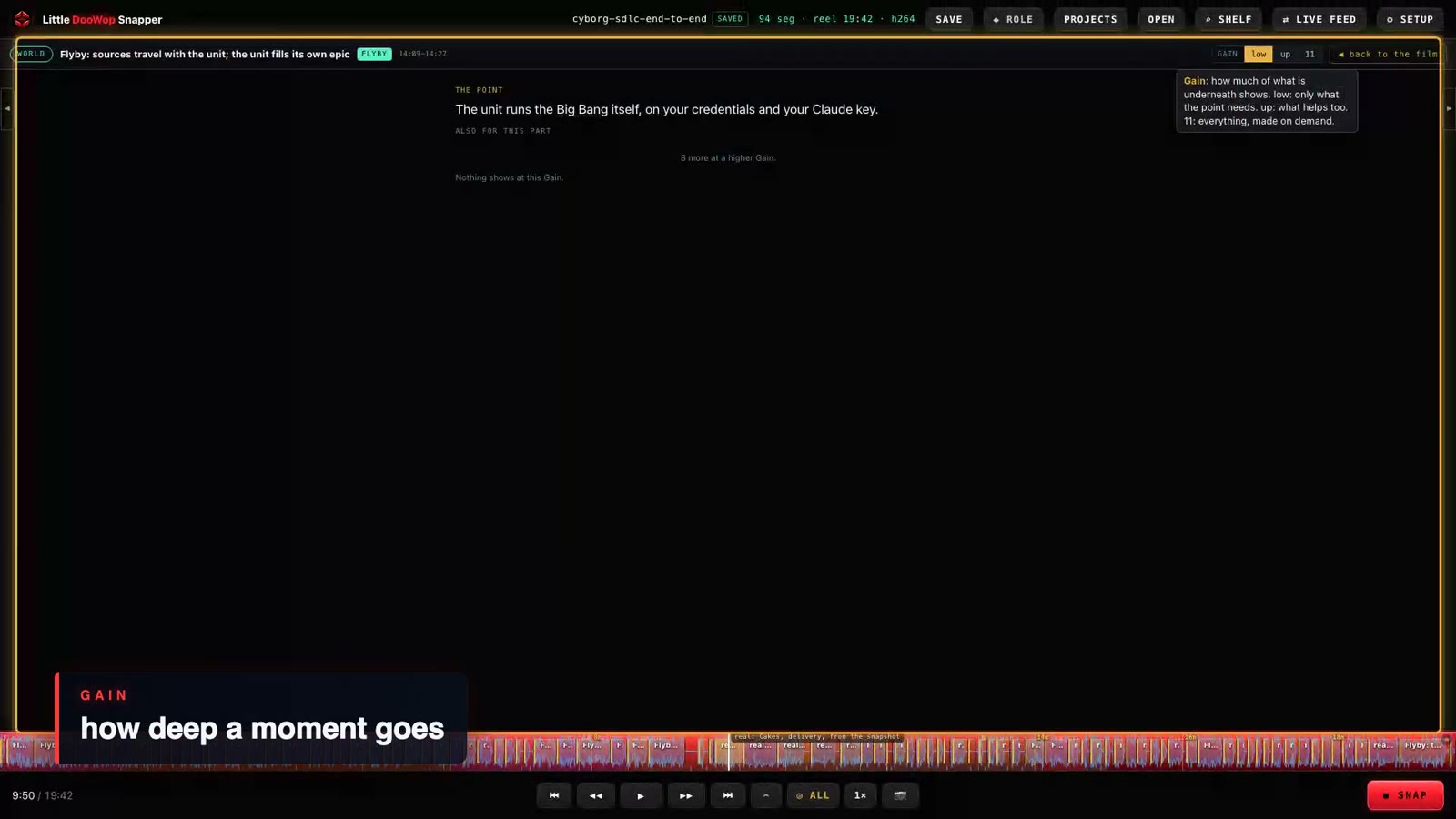
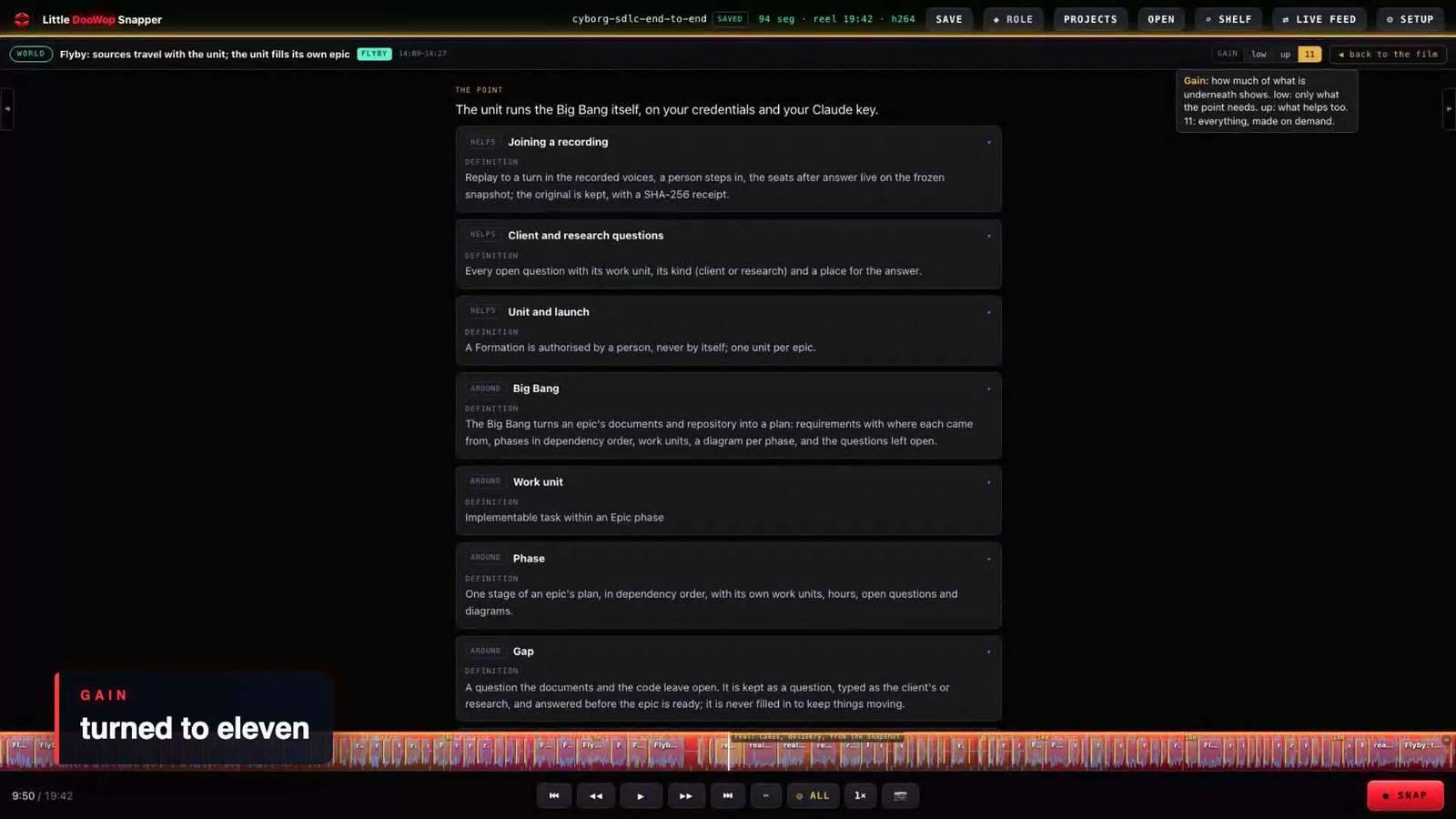
Gain sets how deep a moment goes. At its lowest, a moment asks nothing of you. At eleven, everything around it opens: client and research questions, the unit and its launch, the Big Bang, the phase, the gap (1:26). The same film serves someone who wants the gist and someone who wants to go under it.
The path
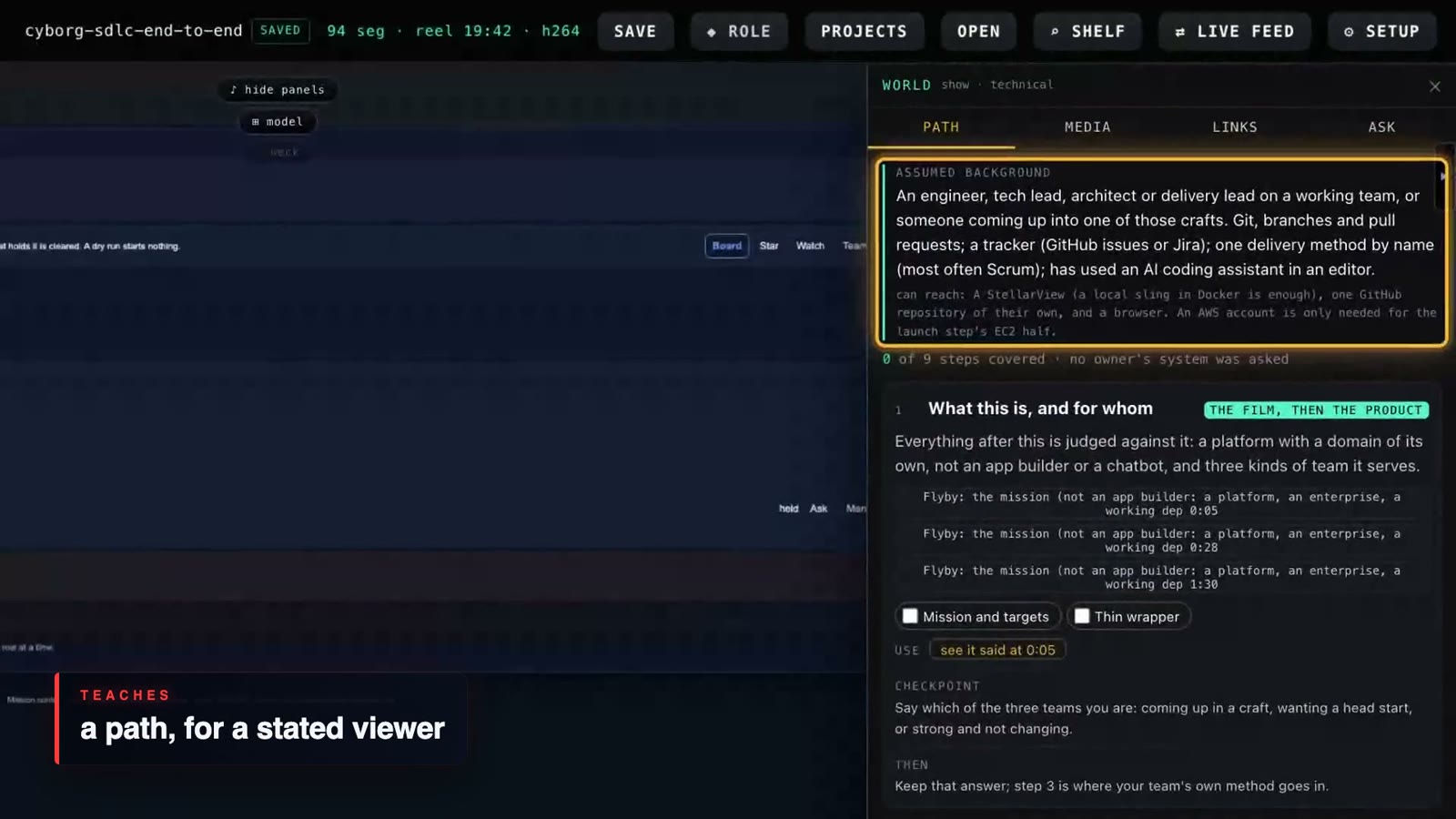
The film shows things in the order they happened. A learner needs them in a different order. The path is that order, written for a stated viewer: who they are (“an engineer, tech lead, architect or delivery lead on a working team, or someone coming up into one of those crafts”), what they already know, and what they can reach. It has nine steps, and each step has what it covers, a moment in the film, and a checkpoint to prove it (1:40).
For this film we wrote the path and the viewer by hand. When a film has none, the build proposes one, from a prompt template in HAL fed with StellarView’s own context. You can read and change that template like any other.
It tests
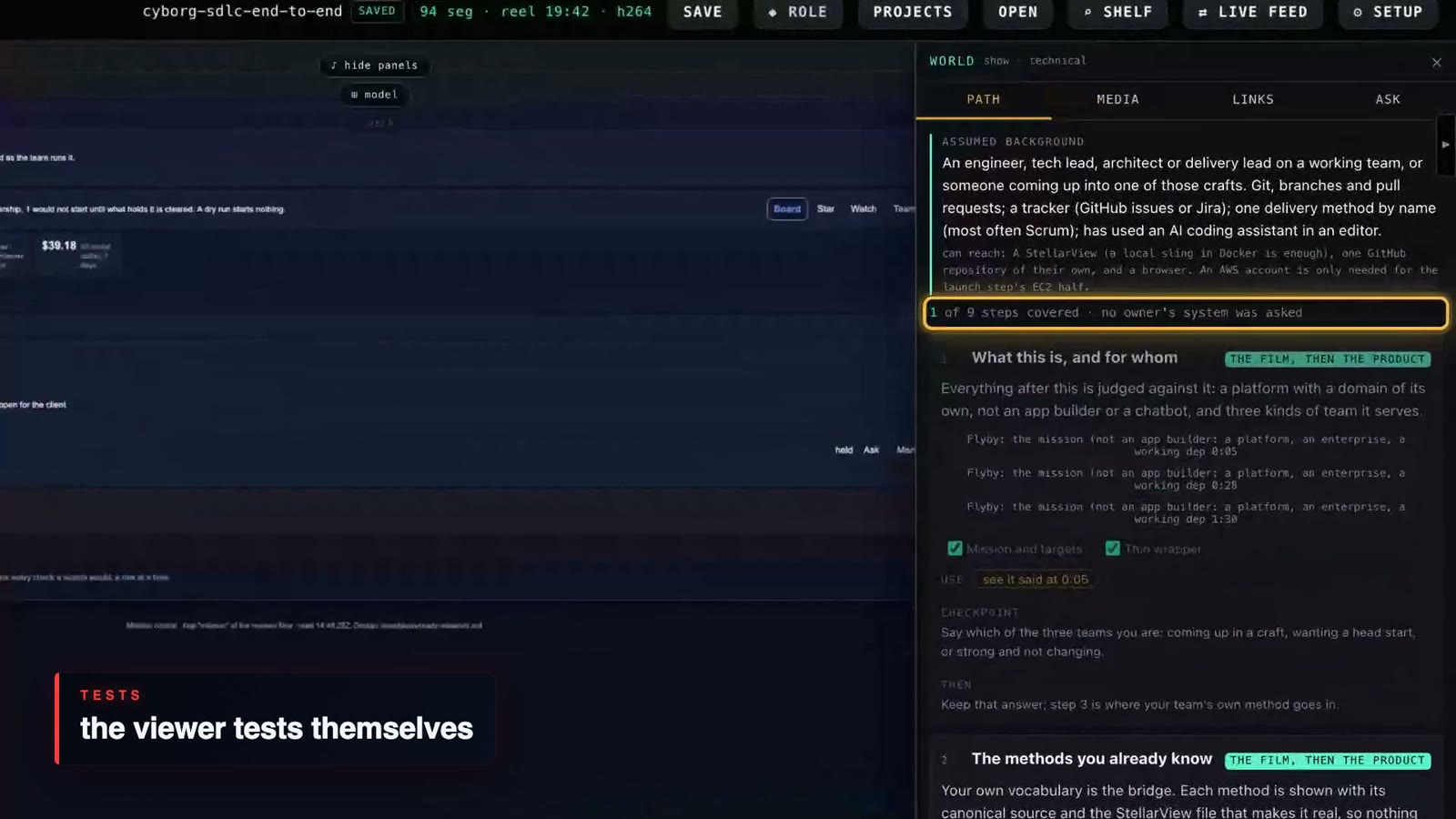
A viewer ticks what they have, and the path counts it: one of nine. The World also tests itself. Every topic is defined, with zero gaps and zero loose ends, and that is measured with no model call at all (1:56). A model that can say what is missing from itself is one you can put in front of a team.
It reports
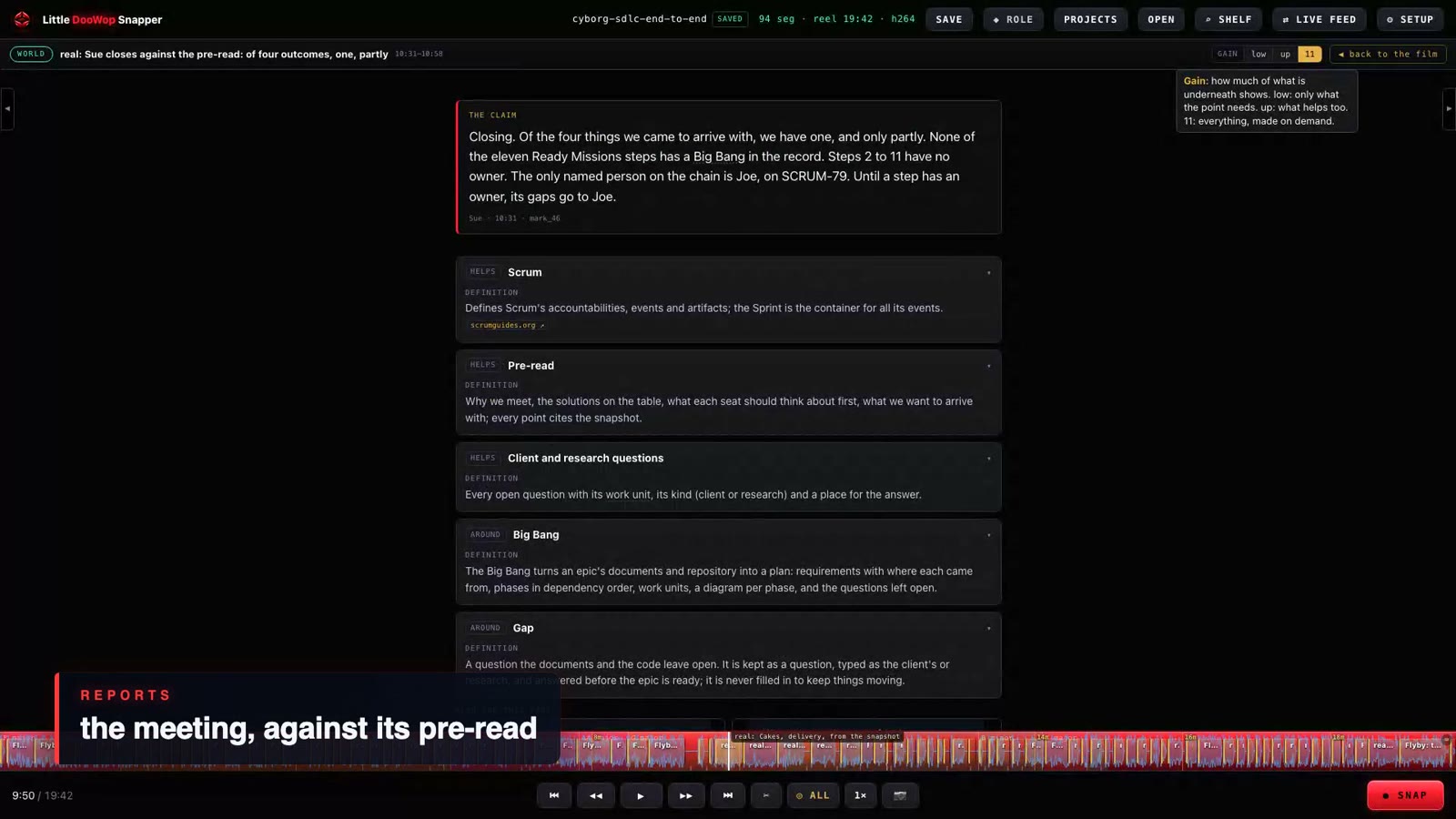
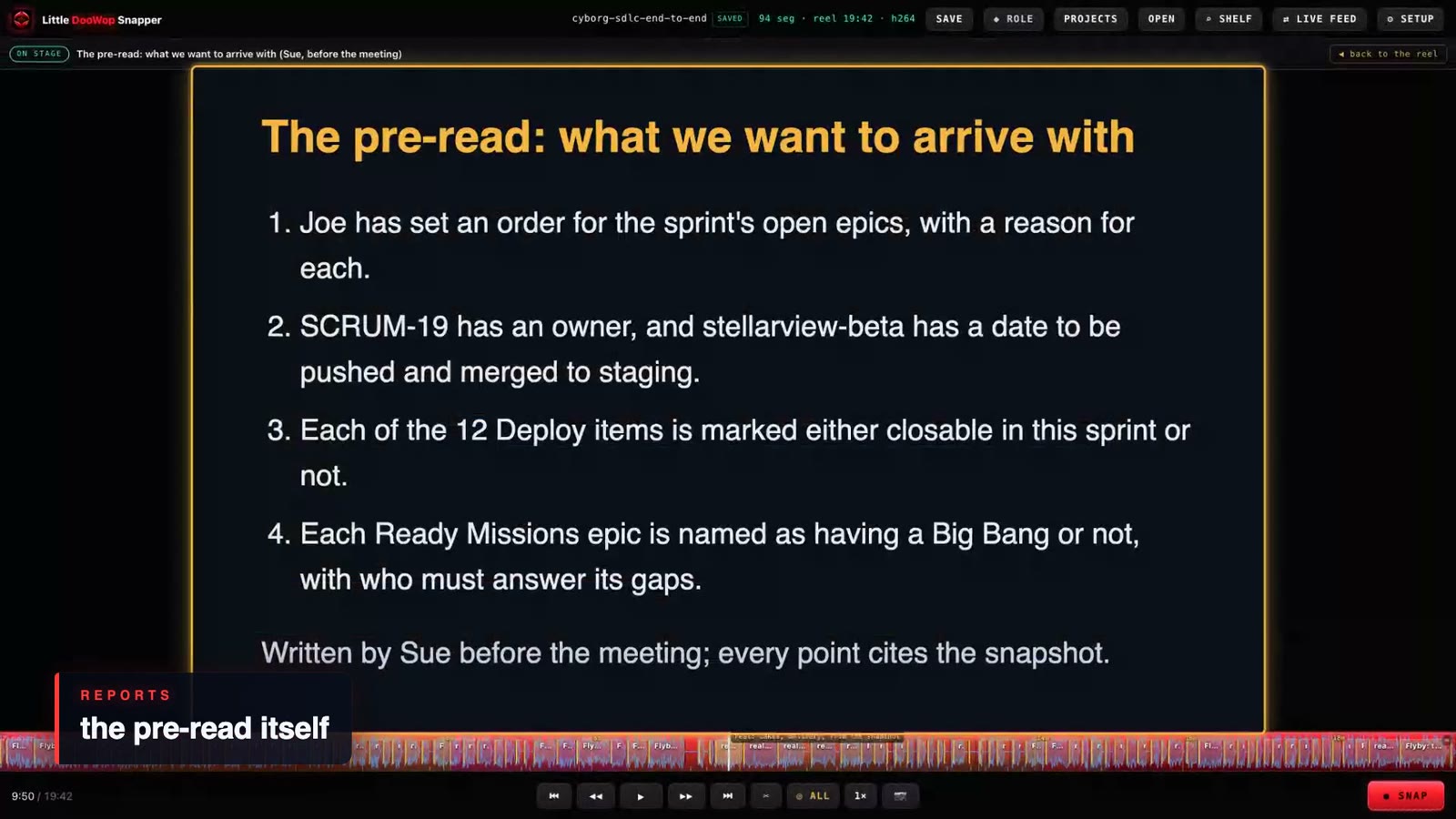
Sue, the seat that runs the meeting, closes it against its pre-read (2:15). The pre-read was written before the room met, and it named four things we wanted to arrive with:
- an order for the sprint’s open epics, with a reason;
- an owner for SCRUM-19, and a date for merging the beta branch to staging;
- each of the 12 Deploy items marked closable in this sprint, or not;
- each Ready Missions epic named as having a Big Bang or not, with who must answer its gaps.
We reached one of the four, and only partly. The model keeps that sentence next to the plan. It is the most useful line in it, because it tells the person exactly what is theirs to decide next.
Then there is the receipt: $1.34 in six model calls. The pre-read cost $0.21, and each of the five seats’ turns cost between $0.20 and $0.25, each call’s cost as Claude Code returned it (2:31). It does not include people’s time, the machine or the voices, and the receipt says so on its face.
Every language
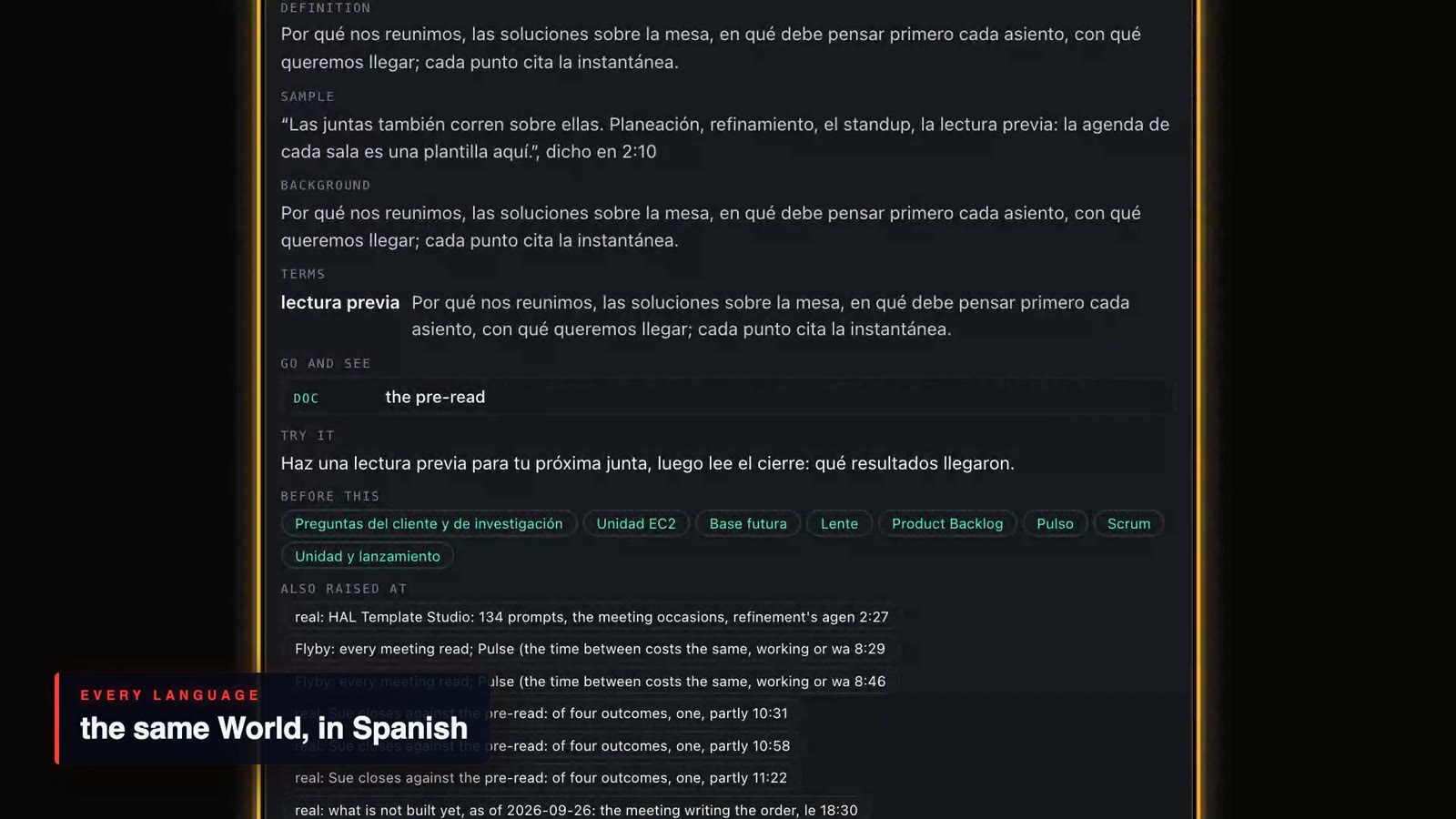
The same World, in Spanish (2:44). The Spanish is a pack laid over the model, not a second model. Every one of its 2,076 strings is tied to the English it came from, so when the English changes, the Spanish string is known to be stale and cannot show as current. The narration is in Mexican Spanish, and Cakes takes the lead. A team that meets in two languages reads one record.
Why a meeting should leave a model
Part one argued that an agent in a meeting must cite a fact or be struck. This is what that rule buys after the meeting ends. Because every claim carries its facts, and every fact carries its snapshot and source, the meeting can be walked, taught, tested and audited later by someone who was not in it. That someone might be a new hire, a client, an auditor, or the next meeting’s pre-read. None of that needs a model call. The expensive part, the meeting, happens once. Keeping what it knew costs nothing.
That is the value in plain terms. A team does not have to remember what the last meeting knew, because the meeting kept it, cited, in a form the next person can learn from.
What does not work yet
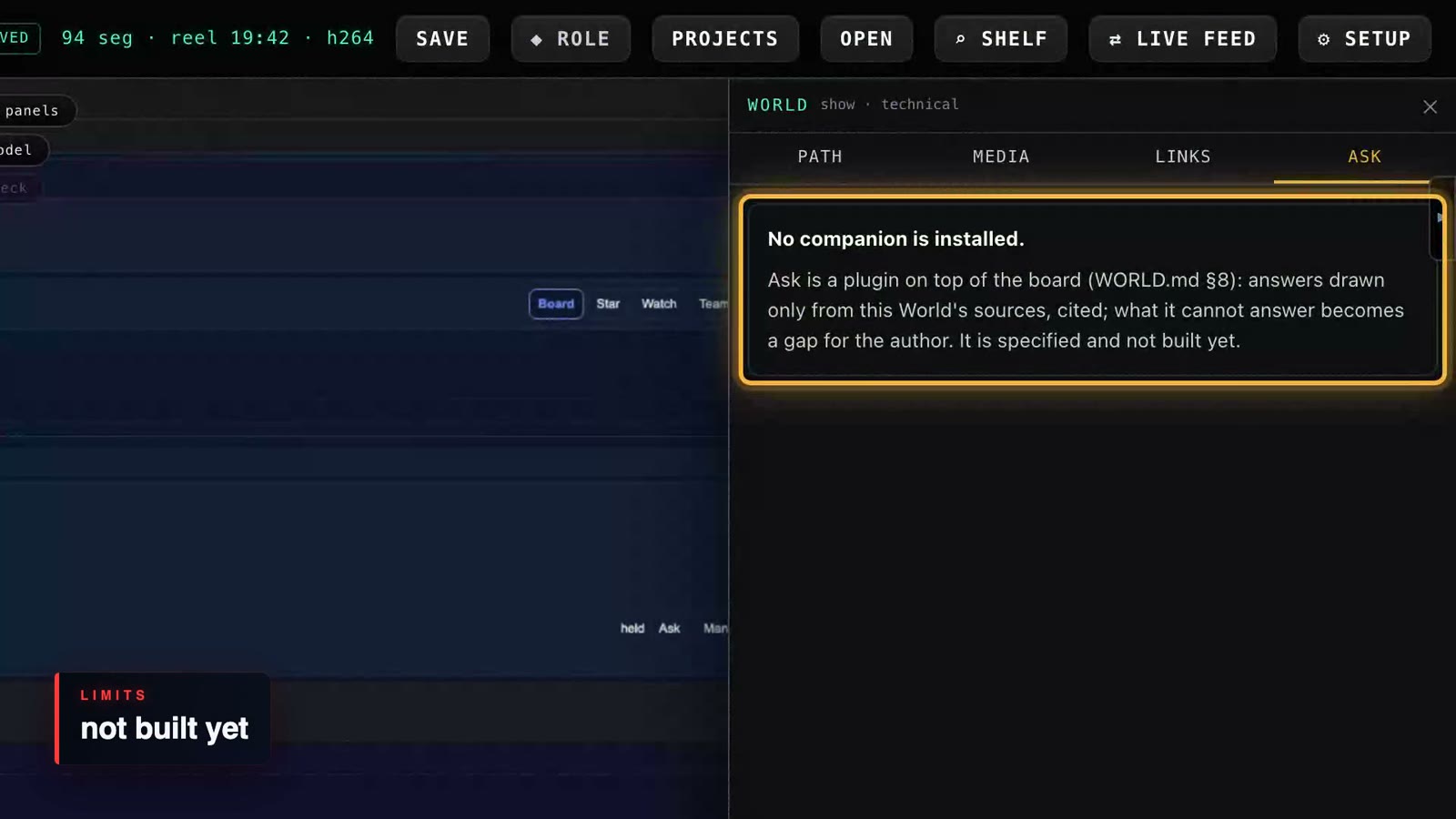
- You cannot ask the World a question yet. The Ask tab is specified: answers drawn only from this World’s sources, cited, and what it cannot answer becomes a gap for the author. No companion is installed behind it. The film says so at 2:54.
- The rule checks that a cited fact exists, not that the sentence is true to it. A test in
StellarView (
evidence-rule.test.js) pins that down. A person reads the facts beside the claim. - Not every room beat carries its facts yet. Five of the seven beats from the meeting do.
- The path and viewer for this film were written by hand. The build’s own proposal exists, and we have not yet shipped a film on it.
- The Learning Design Studio is not public. It runs on our machines today. The films are public.
- The voices are synthetic, the seats are agents, and the drawings are labelled as drawings.
Read more
Part one, the whole lifecycle in nineteen minutes: Every claim cites a fact. Daily notes and downloads are in the Journal. Explore the Stellarverse, the proof site with every film, at stellarverse.stellarview.net.
Credits
Filmed on our own StellarView, our own team and our own repositories, and walked in our own Learning Design Studio. Client names are blurred in every frame. Sue, Cakes and Wolfie are agent seats with synthetic voices. Click any still to see it large, and use the arrows to walk through them all.
Two kinds of knowledge: Scrum from the Scrum Guide, and from the StellarView file that makes it real
›