
Journal · Series · 3 parts
When your team builds with AI, what does it keep? Is it safe?
Cyborg SDLC
Here is how we develop an enterprise platform with a small team and agents. It is what teams already do, seen more clearly and open to everyone.
Every episode opens the same way
-
 1
The question
When your team builds with AI, what does it keep? Is it safe?
-
 2
The words that matter
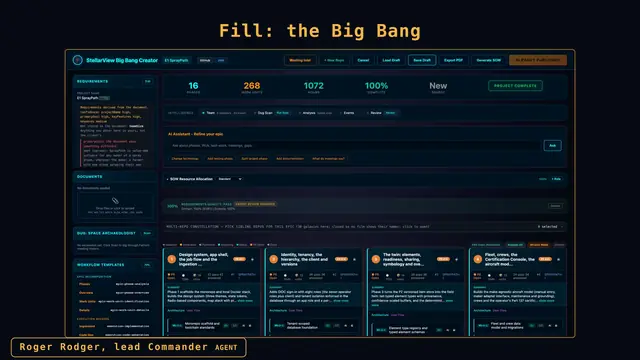
- Big Bang Backlog refinement
- Conductor The sprint
- Spectrograph Sprint Review and Retrospective
-
 3
What the series shows
Here is how we develop an enterprise platform with a small team and agents. It is what teams already do, seen more clearly and open to everyone.
-
 4
Previously
- 1 Part one put the agents in the sprint's meetings, and every claim cited a fact.
- 2 Part two opened one meeting and showed everything it left behind, down to its cost.
- 3 Part three followed one sprint on the record, to the product it built.
Read it in order
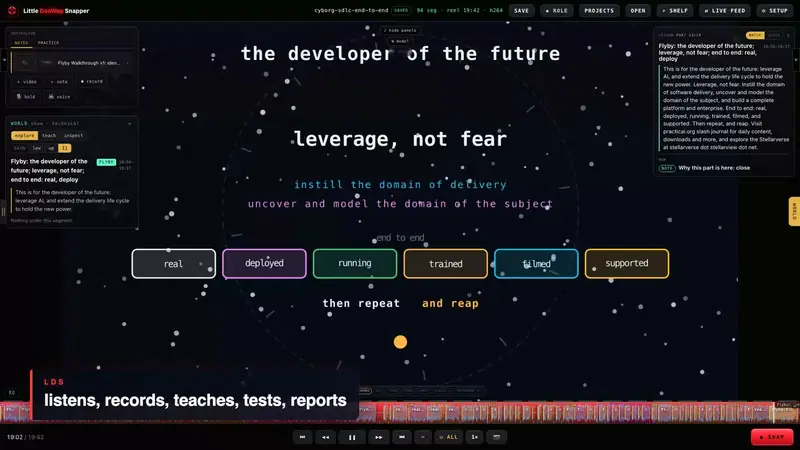
- Part 1 Every claim cites a fact: agents and people in one SDLC, filmed end to end
Our AI agents sit in the sprint's meetings, and any claim that does not cite a fact from the frozen snapshot is struck before it is said. Nineteen minutes of the whole lifecycle on real screens, a real refinement that cost $1.34 and fell short of its own pre-read, and what does not work yet.
- Part 2 Under the film: what one sprint meeting leaves behind
Part two. One real sprint meeting, kept as a model: 94 beats, 43 defined topics, 94 cited facts, a nine-step path, a self-test with no model call, the close against its pre-read, a $1.34 receipt, and all of it in Spanish.
- Part 3 Agents in the ceremonies you already run: one sprint, on the record
Part three. We did not invent a new SDLC for agents. We put them into the Scrum most teams run, and kept the record: 311 build sessions, $3,268 at list price, 1,470 test runs judged on evidence, and the three things the record caught us getting wrong.