
The Hitchhiker’s Guide to StellarView Terminology
The first time someone opens StellarView, they see words like “Galaxy,” “Constellation,” “Cosmic Emissions,” and “Miracle Mode.” They think one of two things:
- “This is ridiculous.”
- “This is ridiculous and I love it.”
Both reactions are correct. Here is your field guide to the wacky, deliberate, surprisingly precise terminology of StellarView, and why every term earns its name.
The Big Ones
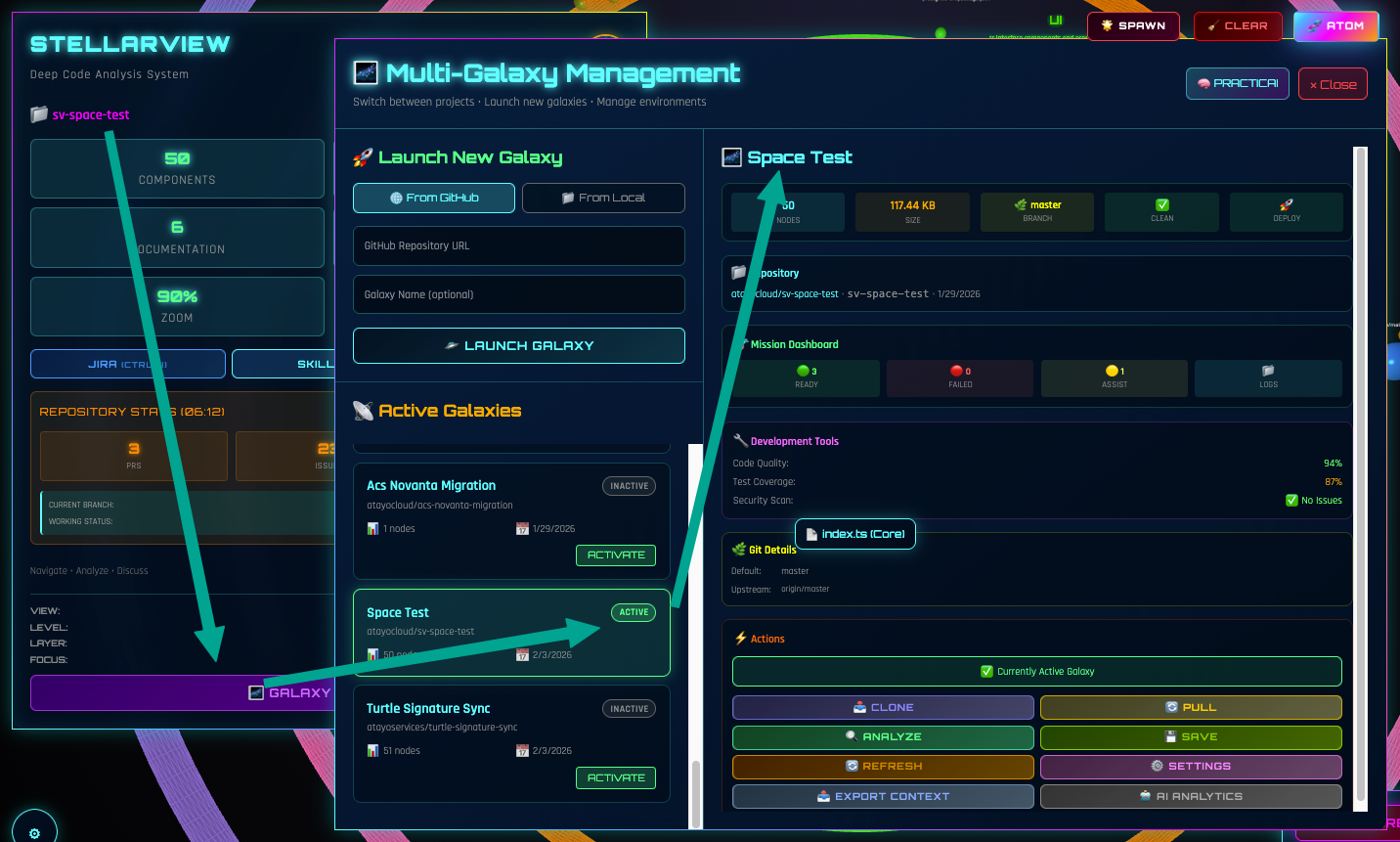
Galaxy
What it sounds like: A spiral of a hundred billion stars. What it actually is: A client project. Your repo, your JIRA space, your credentials, your knowledge base, all scoped to one engagement.
Why the name works: Each galaxy is its own world. Isolated credentials. Its own Space Lake. Its own history. When you switch galaxies, you switch contexts entirely, like traveling between star systems. You don’t accidentally deploy SolarScore’s database migration to WaltersFL because they are literally different galaxies.
Usage: “Switch the active galaxy to PropertyManagement before running the analysis.”
Constellation
What it sounds like: Orion’s Belt but for nerds. What it actually is: Your codebase rendered in 3D. Every file is a star. Stars are grouped into five rings by architectural layer. The constellation IS the architecture.
Why the name works: A constellation is a pattern you see in stars. The code constellation is the pattern you see in files. Core at the center. Infrastructure at the outer ring. The shape of the constellation tells you the shape of the architecture before you read a single line of code.
Usage: “The constellation shows a massive Services cluster, this app is logic-heavy.”
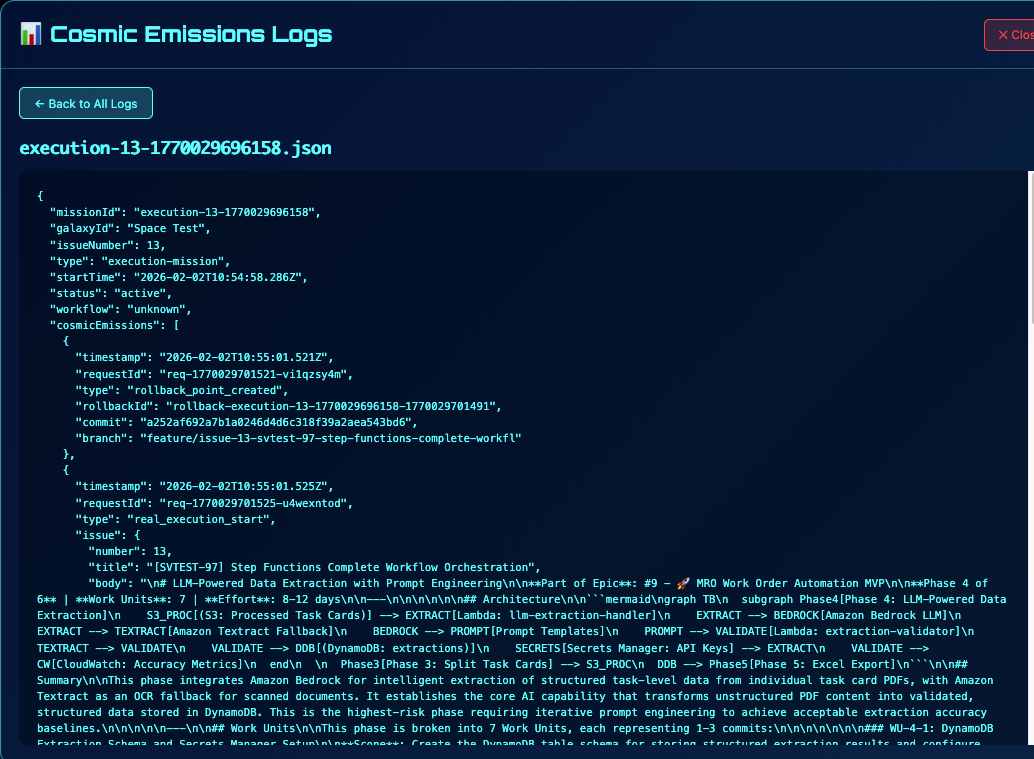
Cosmic Emissions
What it sounds like: Radiation from a supernova. What it actually is: The complete audit trail of every AI interaction. Every prompt sent, every response received, every token consumed, every decision made. Timestamped. Permanent. Reviewable.
Why the name works: Every AI call emits something, tokens, cost, reasoning. Cosmic emissions capture all of it. When you need to know why the AI made a particular architecture decision in Phase 4 of a Miracle run at 3 AM, the cosmic emissions tell you. Compliance officers love this one.
Usage: “Check the cosmic emissions for that execution. I want to see the token costs.”
The Missions
Analysis Mission
What it sounds like: A science team studying an alien artifact. What it actually is: The AI reads your issue, analyzes the codebase, and produces a three-phase Smart Prompt: requirements validation, architecture review, and implementation plan. Posted as comments on the GitHub issue.
Why the name works: It is literally analysis. The AI investigates before it acts. No code written. Just understanding.
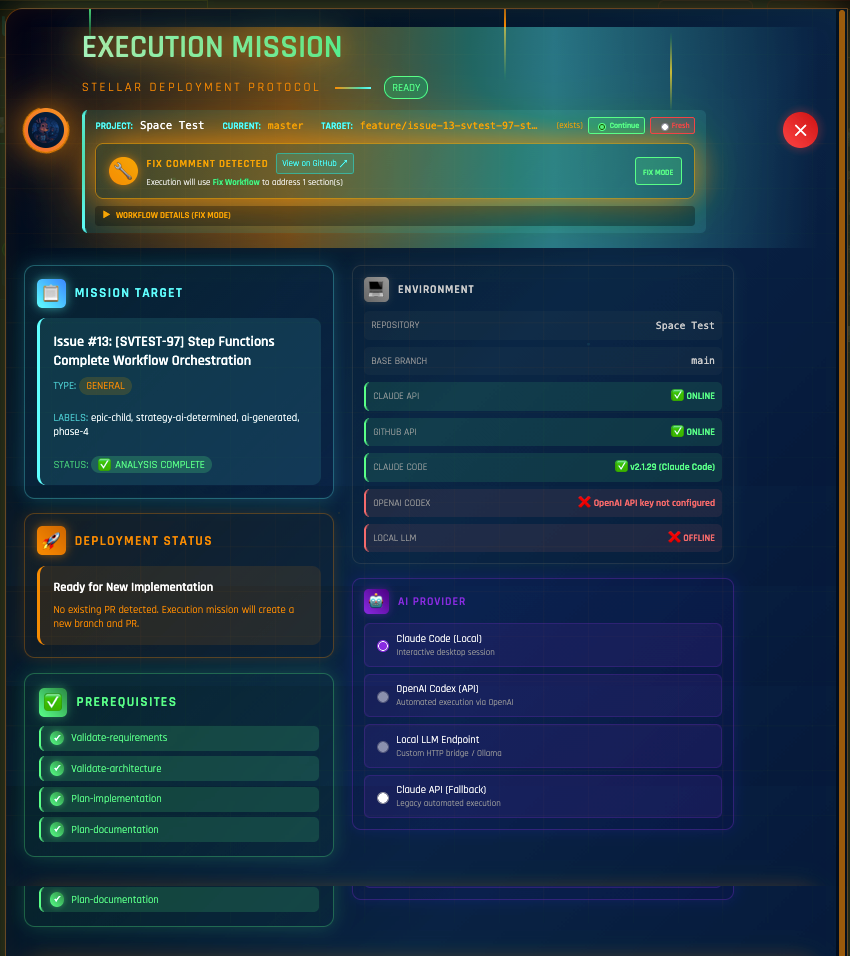
Execution Mission
What it sounds like: A military operation. What it actually is: The AI writes code. Based on the analysis mission’s plan, Claude Code generates files, makes commits, pushes to a feature branch, and opens a PR. All in an isolated worktree so it never touches your working directory.
Why the name works: After analysis, you execute. The plan becomes code. The mission has a clear objective (the GitHub issue) and a measurable outcome (the PR).
Miracle Mode
What it sounds like: Divine intervention. What it actually is: Autonomous execution of an entire epic. Phase by phase: analyze, execute, move to next. Runs overnight. You wake up to PRs.
Why the name works: Because watching a 7-phase epic execute itself while you sleep and waking up to working code on seven branches genuinely feels like a miracle. The name is not ironic.
Usage: “Start Miracle Mode on the SolarScore epic and let it run overnight.”
The Infrastructure
Fleet
What it sounds like: The Starfleet. What it actually is: StellarView’s cloud deployment system. Manages Ghost instances (development environments), Replicant deployments (production), and Construct infrastructure (the underlying AWS resources).
Ghost
What it sounds like: A phantom ship. What it actually is: A headless StellarView instance running on AWS ECS Fargate. Your development environment in the cloud. Accessible via the Transporter Room.
Why the name works: It runs silently, without a visible interface. It is there, doing work, but you cannot see it until you look for it. Ghost in the machine.
Replicant
What it sounds like: Blade Runner. What it actually is: A deployed copy of a galaxy’s application. The production instance. Replicated from the Ghost’s development state to a production-ready configuration.
Construct
What it sounds like: Building blocks. What it actually is: The underlying AWS infrastructure, VPCs, subnets, security groups, RDS instances, provisioned via Terraform and managed by Fleet.
Transporter Room
What it sounds like: “Beam me up, Scotty.” What it actually is: A Cognito-authenticated web portal where team members access Ghost instances through their browser. Terminal access, file browsing, and StellarView controls, all through a browser tab.
Usage: “Give the new developer access through the Transporter Room, they don’t need a local setup.”
The Knowledge Systems
Space Lake
What it sounds like: A lake in space (obviously). What it actually is: The document intelligence pipeline. Ingest any document (PDF, markdown, SQL, code). Three tiers: Bronze (raw), Silver (classified by ontology), Gold (vector-indexed and queryable).
Why the name works: A data lake, but in space. It is exactly what it is. The “space” prefix means it operates within the StellarView cosmos, galaxy-scoped, knowledge-aware, AI-ready.

RAG Companion
What it sounds like: A helpful robot sidekick. What it actually is: A conversational interface that answers questions grounded in your Space Lake’s classified knowledge. Cited sources. Confidence scores. Cross-galaxy intelligence.
Why the name works: RAG (Retrieval-Augmented Generation) is the technique. Companion is the experience. It is your knowledgeable colleague who has read every document in the Space Lake and can cite them by page.
Dug (Space Archaeologist)
What it sounds like: A dog that digs things up. What it actually is: Legacy code analysis and knowledge recovery. Point Dug at an old codebase or Confluence dump, and it excavates patterns, decisions, and tribal knowledge that would otherwise be lost.
Why the name works: Dug digs up buried knowledge. Like the dog from Up who is very excited about every discovery. Except Dug finds architecture decisions from 2019 that explain why the payment service is structured that way.
Usage: “Run Dug on the legacy Confluence export, there are architecture decisions buried in there.”
The Tools
Big Bang
What it sounds like: The origin of the universe. What it actually is: The Epic Creator. Where specifications become executable epics with phases, work units, architecture diagrams, and gaps.
Why the name works: An epic is the big bang of a project. From nothing, a specification, comes everything: phases, code, tests, documentation, deployment. The universe of the project begins here.
Vibe Creator
What it sounds like: Something a DJ uses. What it actually is: Rapid application prototyping. Describe what you want, choose a stack, and the Creator agent generates a working application with database, API, and frontend. In minutes, not days.
Why the name works: The vibe is the vision before it has form. The Vibe Creator gives it form without the grief of traditional implementation. You hold the vibe, the tool manifests it.
HAL (Template Studio)
What it sounds like: “I’m sorry, Dave. I’m afraid I can’t do that.” What it actually is: The Smart Prompt template management system. 110+ templates that control how the AI behaves during every mission. Monaco editor, variable inspector, inheritance chains.
Why the name works: HAL controls the AI’s behavior. Unlike the movie, this HAL does what you tell it.
Starkeeper
What it sounds like: A guardian of the stars. What it actually is: The code review system. Five specialized commanders review every PR:
- Aegis: Security review
- Titan: Architecture review
- Nexus: Business logic review
- Phoenix: Quality and testing review
- Zephyr: Style and conventions review
Why the name works: The Starkeeper keeps the stars (your code) in order. Each commander guards a different aspect of quality. Together, they are a five-commander review board that never sleeps, never gets tired, and never says “LGTM” without actually looking.
The Secret Weapon
Wormhole
What it sounds like: A shortcut through spacetime. What it actually is: Cross-galaxy context sharing. Query knowledge from one galaxy while working in another. “What did we learn about payment processing in the FinTech galaxy?” answered while you are building the e-commerce galaxy.
Why the name works: It is literally a wormhole between galaxies. Knowledge travels across engagement boundaries without the practitioner having to switch contexts.
The Full SDLC Mapping
For the skeptics who think the space theme is pure whimsy:
| StellarView Term | Traditional SDLC Equivalent |
|---|---|
| Galaxy | Project / Engagement |
| Constellation | Architecture Diagram |
| Big Bang | Requirements → Design |
| Analysis Mission | Requirements Validation |
| Execution Mission | Implementation |
| Miracle Mode | Sprint Execution (automated) |
| Cosmic Emissions | Audit Trail |
| Space Lake | Data Lake / Knowledge Base |
| RAG Companion | Knowledge Management |
| Fleet | Infrastructure / DevOps |
| Ghost | Dev Environment |
| Replicant | Production Deploy |
| Starkeeper | Code Review |
| Dug | Legacy Analysis |
| Forge | QA / Verification |
| Wormhole | Cross-Project Knowledge |
Every term maps to a real SDLC concept. The space theme is not random, it creates a coherent mental model where the relationships between concepts are intuitive. A galaxy contains constellations. Missions operate within galaxies. The fleet transports between them.
The terminology is ridiculous. The system it describes is rigorous.
Don’t panic.