
The Control Layer, Shown, Part 1: The Plane You Can See
Two essays this year named the thing we have spent years building. In The Control Layer, Mozilla.ai’s John Dickerson argues that the next era of AI is infrastructure, not just models. He backed the claim by shipping Otari, an open-source control plane for LLMs. In Agent Developer Workspaces, Monaco’s John Tracy describes a manager agent that spins off dozens of intern agents, each in an isolated instance with production-like data. He backed that by building Monacoder.
Both are right. This series is not a rebuttal; it is a thank-you and a stack of screenshots. Over three parts we show what their convictions look like running in production. Part 1 honors Dickerson’s argument directly: control you can see.
Dickerson is right about the moat
The sharpest line in the piece is also the simplest:
“Control is the new moat… who can deploy AI reliably, cost-effectively, and safely at scale? That’s a question of infrastructure.”
He is right that the shift is about adoption velocity, “AI in production has gone from a handful of well-resourced tech companies to thousands of teams across every sector,” and right that the complexity of governing hundreds of parallel agents is “orders of magnitude beyond what current infrastructure handles.” Otari answers that with a control plane: visibility, policy enforcement, multi-provider flexibility. It is the correct instinct, open-sourced.
We took the same instinct in a different direction: if control is the moat, then you should be able to look at it. Not a dashboard of numbers about it. Watch it fly.
What a control plane looks like when you can see it
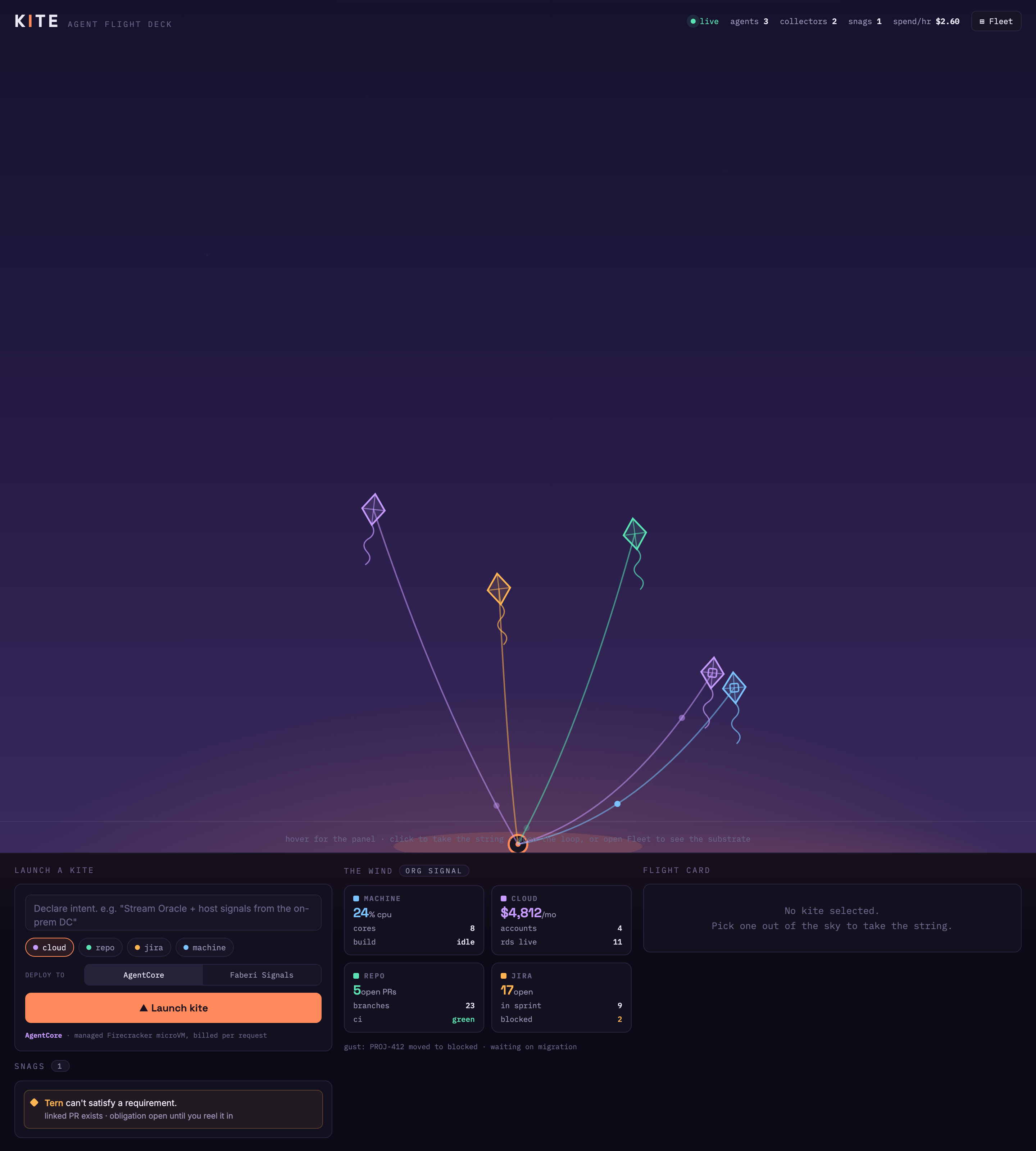
This is Kite, the flight deck in Faberi.ai. Every agent is a kite. You launch one by declaring intent, “stream Oracle and host signals from the on-prem data center,” then pick a kind (cloud, repo, Jira, machine), and deploy it to AgentCore or to Faberi Signals. The wind is your org signal: real CPU, real cloud spend, real open PRs, real sprint state. A gust, “PROJ-412 moved to blocked,” moves the whole sky. Each kite is tethered to a string you hold; take it any time. When an agent cannot satisfy a requirement, it snags, and the obligation stays visible until you reel it in. Nothing fails silently.
That is Dickerson’s control plane, made literal. The moat is not an abstraction on this screen. It is a thing in your hand.
Governance the model can’t skip
Control is only a moat if it is enforced. Here is the same fleet from the inside, in Loop Studio, the visual IDE for AgentCore:
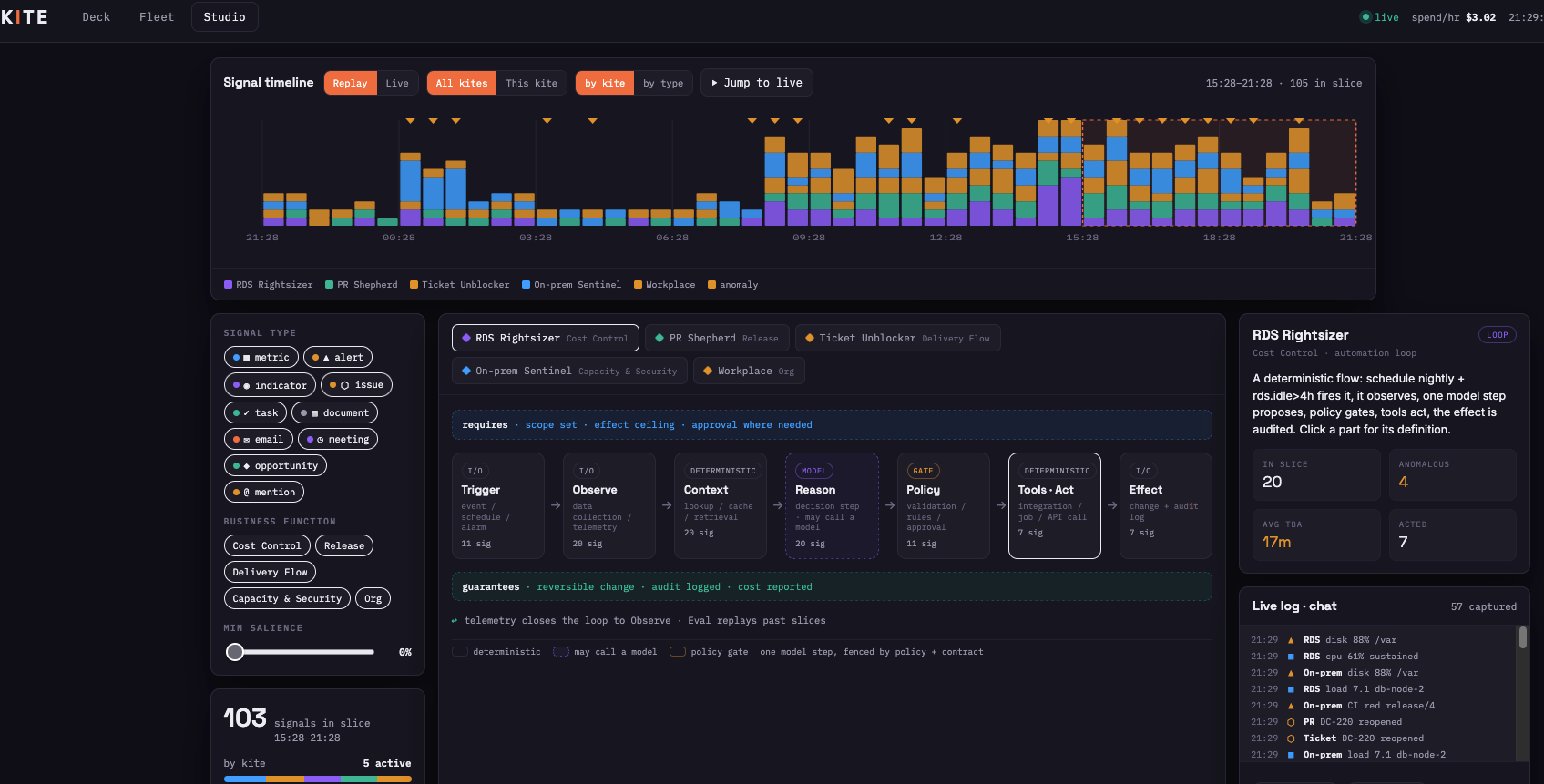
Every signal matches a kite and transmits down the string to the Lambda/AgentCore logic. You can pause and step the trace like a debugger (Trigger → Observe → Context → Reason → Policy → Tools · Act → Effect), reading the real X-Ray span and CloudWatch logs at each frame. One model step, fenced by a policy gate that runs outside the reasoning loop. That is the same architecture AWS ships with Cedar and Gateway, and the same one Dickerson is pointing at: authorization the model cannot argue its way around.
Look at the contract on that screen. Each flow requires a scope, an effect ceiling, and approval where needed. Each flow guarantees three things: reversible change · audit logged · cost reported. This is “which model said what, when, to whom, and why” as a replayable timeline you can scrub.
Cost, in the open
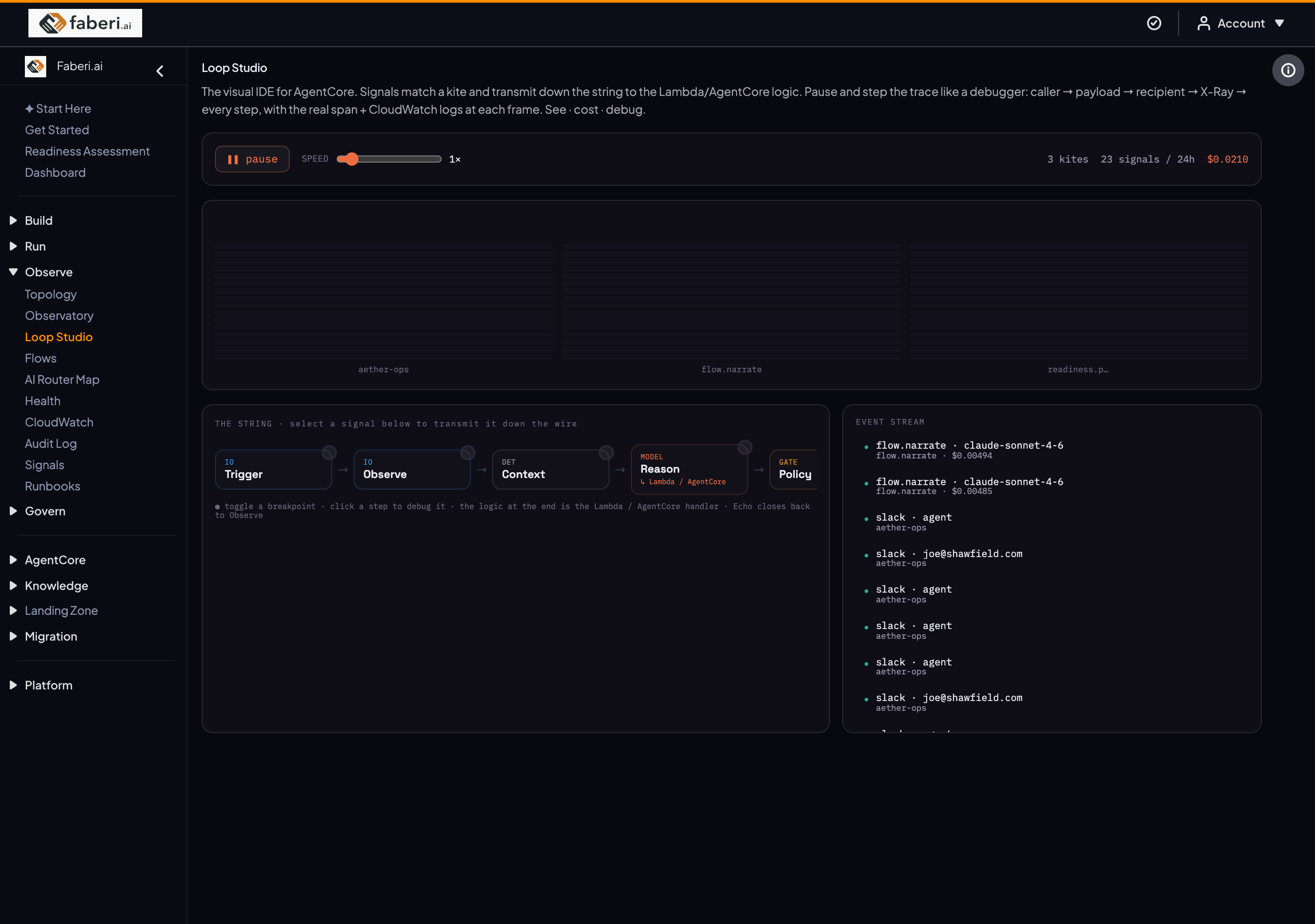
Dickerson names cost opacity as a core failure of the current stack. On the flight deck the spend rate sits in the header ($2.60/hr, $3.02/hr), and in Loop Studio the cost is resolved per frame, per model call, as the kite transmits. The Observatory rolls it up across the whole fleet:

No surprise invoice at the end of the month. The cost is a number on the same screen as the work that produced it, attributed to the agent, the model, and the step. Cost-effective at scale is not a slogan here; it is instrumentation.
The point of Part 1
Dickerson said control is the moat and open-sourced a control plane to prove it. We agree so completely that we made the control plane something you can watch fly, govern frame by frame, and cost in the open. Same conviction, shown.
Next, Part 2: The Manager and the Interns. John Tracy’s Monacoder spins a manager agent off into dozens of interns, each with its own seeded, production-like data. We fly that too, with one distinction that matters: the interns run in parallel where parallel makes us more accurate (analysis, gap resolution), and the code itself is written by a single agent, sequentially, through the whole plan. We will show every screen.
References: The Control Layer by John Dickerson, Mozilla.ai · Agent Developer Workspaces by John Tracy, Monaco · Amazon Bedrock AgentCore