
The Colosseum, 16:30. One Roman arena, opened until it becomes a coast, a school and a day's work, with the source of every fact on screen. Narrated by Sue, PractiCAI's Mission Coordinator. Music: Devil's Dream, performance audio courtesy of Billy Gilmore and The Grass Is Dead. Tangerine Moon work preview, Stonehouse. The Sphere overture mix, ours.
Sixteen minutes, one arena, taken apart until it shows you a coast, a classroom and the work that built the film.
The title is a big claim, so its scope comes first. It is about our corner of the AI world: the place where a creator and a team of agents make software and films together. In that corner, a Roman amphitheatre and a school field trip changed what we build and how we show it. The film above is the evidence, and every link in the chain below has a source.
What you are watching
- 0:04 to 3:09, one component, opened. The Colosseum as a model of eleven parts, each carrying a source and a status. It is read with information laid over it, lifted apart in four layers to find the tunnels under the floor, re-read as spectacle, as a calendar in stone (AD 70 to 72, 217, 443, 523 and 1349) and as an instrument that pulses to the beat.
- 3:09 to 4:29, under the arena. An 1877 plan laid beneath the model and flown through. Ancient accounts say the arena could be flooded. Scholars note there is no physical evidence of it at the remains, and the film says so.
- 4:29 to 5:45, one component, every medium. The same model becomes a web page, a map, a print, an animation and a film, each dissolving into the next.
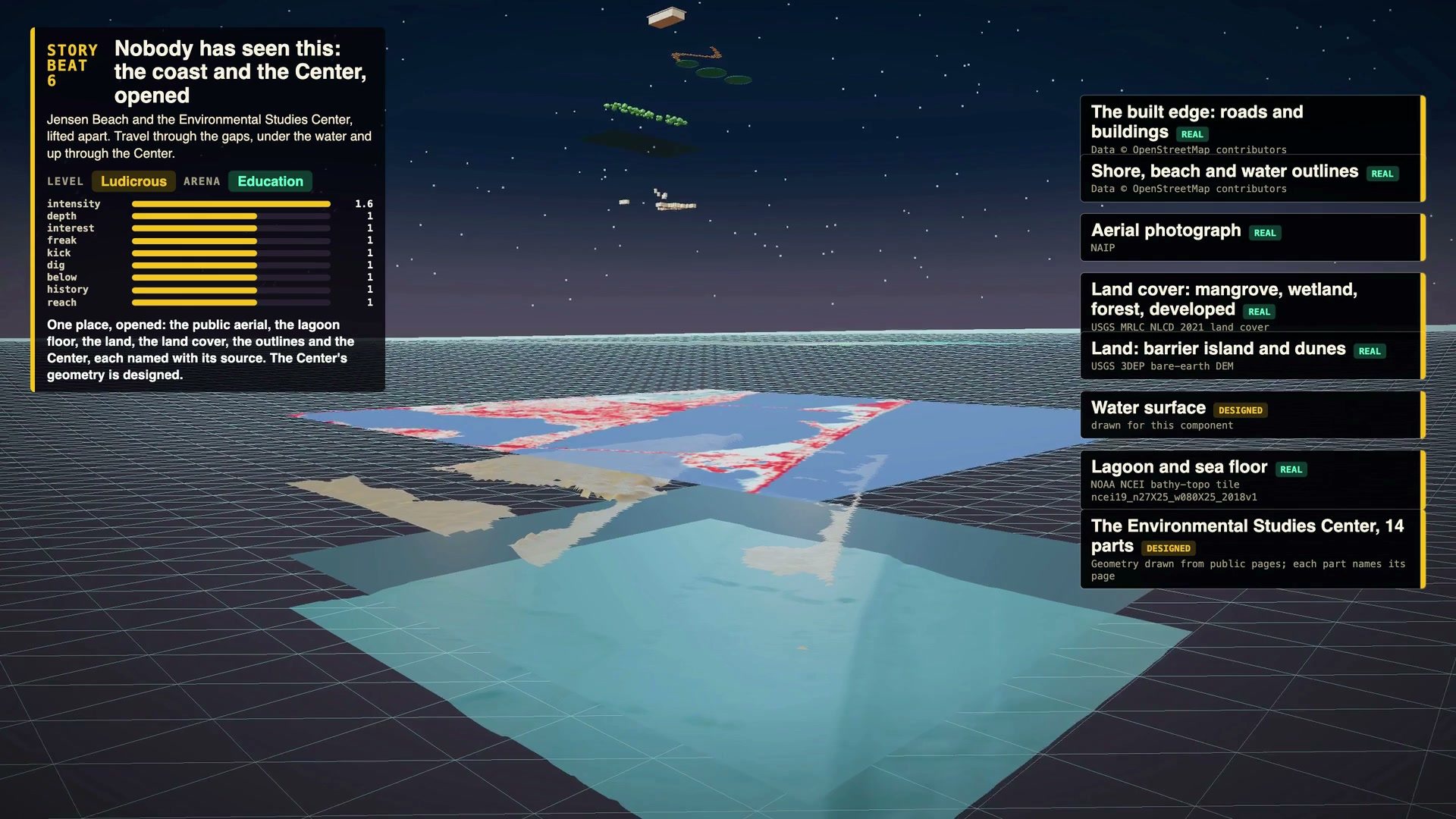
- 5:45 to 8:45, the Sphere and the coast. The Sphere Studio opened into its parts. Then a stretch of the Florida Treasure Coast built from public data, and the Martin County Environmental Studies Center in fourteen parts, each labelled real or designed.
- 8:45 to 16:30, the work and the dare. Real screens of the product at work: its process log, a commentary over the live Sphere Studio, a day of work in dissolves, six arenas that each land in one real mechanism, and the dare the whole film came from. It closes on the word STELLARVIEW.
The chain, link by link
1. The Romans built a place for a crowd. The film’s facts come from the English Wikipedia article on the Colosseum, read on 18 November 2026. It was ringed by eighty entrances at ground level, seventy-six of them for ordinary spectators. Each entrance, exit and staircase was numbered. It could hold an estimated 50,000 to 80,000 spectators at various points in its history. The tunnels under the arena floor, the hypogeum, were added later under Domitian, and eighty vertical shafts reached the arena from below.
2. A place is a component with levels. We build a place the way our Exploder kit builds anything: as parts, and every part carries its source and a status, real or designed. The Colosseum model has eleven parts. Opening it layer by layer produced the levels and the dial the kit then used on the coast and the Sphere as well.
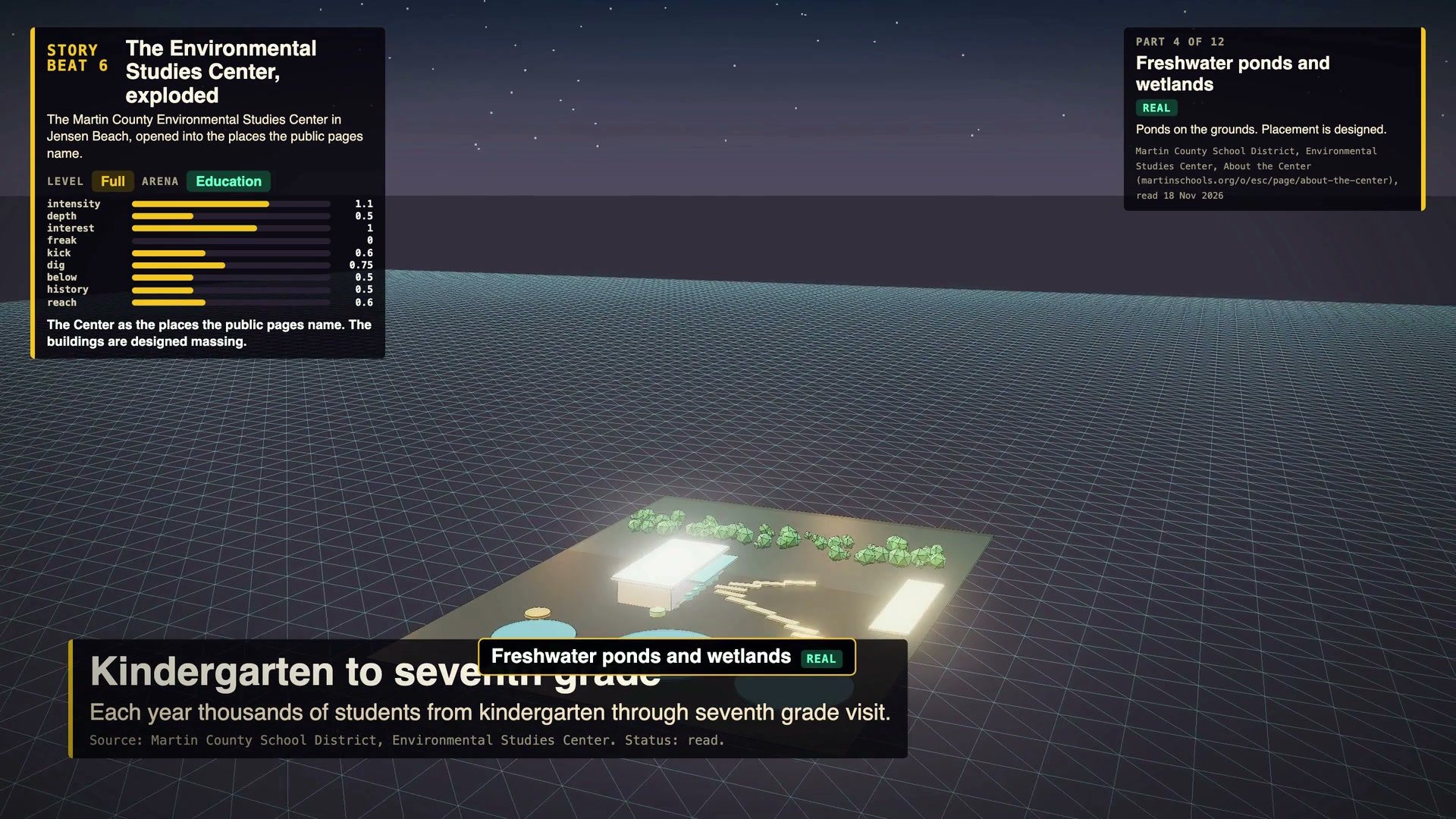
3. The place had an audience. The Martin County Environmental Studies Center has been, in the words of its district page, “a cornerstone of environmental education since 1972”. Each year, thousands of students from kindergarten through seventh grade take part in its programs, so fifth graders on field trips are among them. Its supporting council was established in 1978. The aim behind our film was an educational one: a lesson that school groups could watch on a trip, in a venue the size of the Sphere, where the Sphere Studio panel in the film lists 17,600 seats as a sourced figure. That is the aim we set. It is not a booking.
4. The film was made with agents, in the open. At 9:27 the film shows its own process log, with the real entries and their times. A creator sets the direction and the agents do the detail, and the log keeps every change. Each fact in the film has the sentence it came from. A fact we could not find a source for was dropped.
5. It began with a dare. In the words of the film’s author, Joe: “Everything here came from a dare.” The Sphere came from a dare to use the Contractor Causeway and the Exploder to explode the Sphere, and the same method then opened the coast.
6. The question of the year. On 17 November 2026 the Cambridge Dictionary named “human” its Word of the Year 2026, defining it as “having the qualities, faults, and feelings that people have, as opposed to gods, animals, or machines” (cam.ac.uk, read 18 November 2026). The film shows that line, dated and sourced, at 15:49. Cambridge has not seen our film and does not endorse it. We took the question up before it had a name, and the word of the year says the question is current.
What changed
The Romans gave us the shape: a place with entrances, levels and a crowd to move through it. The field trip gave us the standard: an audience that deserves to be told where every fact came from. Together they changed how we build. We now make a place as a component with sourced parts, we show its sources on screen, and we make the film with agents so that a creator stays in the direction of it. That is the change this title claims, in our corner of it.
Sources and licences
- Colosseum facts, plans and the naval and animal-hunt history. English Wikipedia, articles Colosseum, Naumachia and Venatio, read 18 November 2026. Text is CC BY-SA 4.0, and the film cites facts, each with its source sentence.
- Piranesi, Views of Rome: The Colosseum (1776). The Cleveland Museum of Art, accession 1922.225, CC0 (Open Access).
- Plan of the Colosseum, 1877. Daremberg and Saglio, Dictionnaire des antiquités grecques et romaines, vol. I, via Wikimedia Commons, public domain as listed there.
- Plan and elevation, Roma descritta ed illustrata. The British Library scan, no restrictions as listed on Wikimedia Commons.
- Section of the Flavian Amphitheatre. Charles Herbert Moore, via Wikimedia Commons, public domain as listed there.
- Terrain, land cover and map data for the coast. USGS 3DEP bare-earth elevation and NAIP aerial photography. NOAA NCEI bathy-topo tile ncei19_n27X25_w080X25_2018v1. USGS and MRLC NLCD 2021 land cover. Data © OpenStreetMap contributors (ODbL).
- The Environmental Studies Center. Martin County School District, Environmental Studies Center pages (About the Center and Environmental Studies Council), read 18 November 2026. Facts are cited and no text or image is reused beyond short quotation. Also Greg Gardner, “The Field-Trip School”, Indian River Magazine, March 2010, page 52. Historic images from the Martin County Library System (Martin County Memory Project).
- Photograph. Judy Gallagher, American Alligator, Anhinga Trail, Everglades National Park, CC BY 2.0.
- The Sphere Studio screens and every other product screen. Our own.
- The word of the year. Cambridge Dictionary, cam.ac.uk, 17 November 2026, quoted briefly.
- Music. Devil’s Dream, performance audio courtesy of Billy Gilmore and The Grass Is Dead. Tangerine Moon work preview, Stonehouse. The Sphere overture mix, ours.