

The Skill Builder: How Practice Compounds
Every consulting engagement produces two things: a deliverable for the client, and patterns that could benefit the next client. The deliverable ships. The patterns evaporate.
StellarView’s Skill Builder captures the patterns.
What is a Skill?
A skill is a packaged, reusable pattern that StellarView can inject into any future project. Not a library. Not a framework. A set of instructions, templates, and code patterns that the AI uses as context when generating new code.
Anatomy of a Skill
Every skill has:
skills/{skill-id}/
├── SKILL.md # What this skill does, when to use it
├── README.md # Human-readable documentation
├── package.json # Metadata and dependencies
├── resources/knowledge/ # Reference materials
│ ├── patterns.md # Code patterns and conventions
│ └── examples.md # Real usage examples
└── .stellarview/
 └── resources.json # Resource registry with AI-generated metadata
The SKILL.md is the critical file. It tells the AI: “When this skill is active, here is how you should generate code.” It includes naming conventions, architectural patterns, anti-patterns, and examples.
The Skills That Exist Today
spawn-crud: The foundational pattern. Full CRUD application scaffolding with parent/child navigation, data validation, error handling, and responsive layouts. Every Vibe Creator project starts with this.

capability-database-postgresql: PostgreSQL-specific patterns: connection pooling, migration management, seed data conventions, query optimization patterns. Loaded automatically when a project selects PostgreSQL as its database.
capability-database-mysql: Same patterns adapted for MySQL: different connection handling, different migration syntax, different optimization strategies.
capability-database-sqlite: Embedded database patterns for local development and lightweight deployments.
Domain starters: Industry-specific templates that pre-fill the Creator chat:
- Blog platform starter
- Booking system starter
- CRM starter
- Directory starter
- Inventory management starter
- LMS (learning management) starter
- Recipe/content management starter
- Ticketing system starter
Each starter is a prompt that carries domain knowledge. The blog starter knows about post/category/tag relationships. The CRM starter knows about contact/opportunity/pipeline patterns.
How Skills Compound
Engagement 1: SolarScore
Building SolarScore, we created patterns for:
- Trust scoring algorithms (weighted multi-factor scoring)
- Proposal analysis (document comparison against benchmarks)
- Regulatory compliance checking (state-by-state rule engines)
These patterns live in SolarScore’s codebase. Without the Skill Builder, they stay there.
Engagement 2: A Different Solar Client
Same industry, different client. The Skill Builder extracts SolarScore’s patterns into reusable skills:
domain-solar-scoring, the trust scoring algorithm, parameterizeddomain-proposal-analysis, document comparison patternsdomain-regulatory-compliance, rule engine structure
When the new client’s Vibe Creator session starts, these skills are injected. The AI doesn’t reinvent trust scoring. It applies the proven pattern.
Engagement N: The Compound Effect
Every engagement adds skills. Every skill accelerates the next engagement. The firm’s code quality improves because skills encode best practices. Junior practitioners produce senior-level output because the skills carry the firm’s accumulated wisdom.
Engagement 1: 5 days → 3 new skills
Engagement 2: 3 days → 2 new skills (building on 3 existing)
Engagement 3: 2 days → 1 new skill (building on 5 existing)
Engagement N: hours, not days
HAL Template Studio
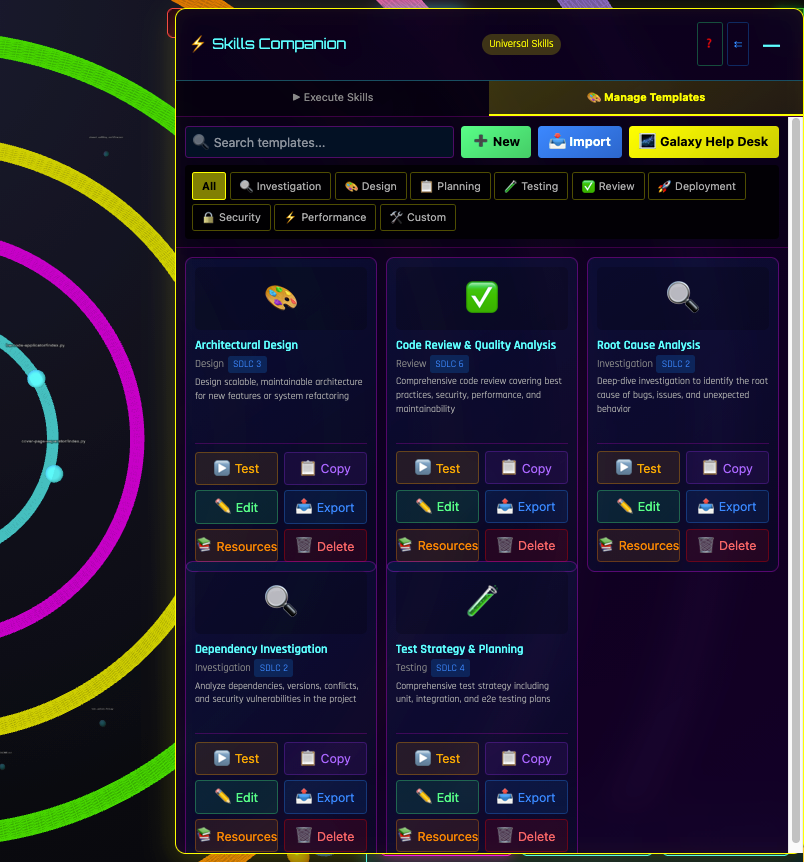
Skills are managed through the HAL Template Studio. StellarView’s prompt template management interface.
The studio manages 110+ Smart Prompt templates that drive every AI interaction in StellarView:
- Analysis templates: how the AI investigates code and requirements
- Execution templates: how the AI generates implementation plans
- Review templates: how the Starkeeper reviews code quality
- Skill templates: how patterns are injected into generation
Each template has variables that are filled at runtime with project-specific context. The template execution-newdev receives REQUIREMENTS_VALIDATION, ARCHITECTURE_VALIDATION, IMPLEMENTATION_PLANNING, and DOCUMENTATION_PLANNING from the analysis mission before generating code.
Template Inheritance
Templates inherit from base patterns. The execution-newdev template inherits from execution-implementation-default, which inherits the Prime Directive and PracticAI standards. Every generated line of code passes through the governance framework without the practitioner thinking about it.
The Practitioner’s Workflow
- Build something for a client. Vibe, Epic, Miracle, the normal workflow.
- Identify reusable patterns. What did this engagement teach us? What would help the next client?
- Package as a skill. Use the Skill Builder to create a SKILL.md with the pattern, examples, and anti-patterns.
- Register in HAL. The skill appears in HAL Template Studio, available for all future projects.
- Inject into the next engagement. Vibe Creator and Miracle automatically load relevant skills.
The practice compounds. Not in theory. In code.
Why This Is Different from Libraries
A library is code you import. A skill is context the AI uses to generate better code.
| Library | Skill | |
|---|---|---|
| What it is | Functions you call | Patterns the AI follows |
| Where it lives | node_modules | SKILL.md + knowledge resources |
| How it’s used | import { thing } | Injected into AI context automatically |
| What it produces | Fixed behavior | Adapted implementation per project |
| How it compounds | Dependency management | Knowledge accumulation |
A library gives you a function. A skill teaches the AI how to build the right function for this specific project, informed by every project that came before.
Explore skills: Open HAL Template Studio in StellarView. Browse the skill templates. Create one from your last project’s best pattern.