

From Talk to Running System in a Week
The old rhythm goes like this. The discovery call is Monday. The proposal lands the following Friday. The scope is negotiated the week after. The statement of work signs two weeks from the call. The kick-off happens two weeks after the signing. The first real demo arrives six weeks from the original conversation. The first production system arrives six months later, if it arrives at all.
That is a rhythm from a prior era. It was not wrong then. It was shaped by the fact that each specialist could only hold one phase of the work, and each handoff between specialists cost a week of calendar time because specialists had to meet to agree on what the previous phase meant. The handoffs were the schedule.
The handoffs are gone.
What remains is the work, and the work is faster than the schedule was. The old cycle is now a tax the market will not pay. Six months between discovery and production is not slow, it is a death sentence for the engagement, because by then the client has hired someone else, or pivoted, or lost the budget, or stopped caring.
There is a different rhythm now. Monday to Friday. Same week.
Monday: the talk
The discovery call happens on Monday morning. A potential client describes a problem. An executive who spent last quarter watching a competitor ship says “we need something that does X.” A VP whose team has tried and failed twice this year says “we want to try this differently.”
The Principal does not take notes. She does not scribble requirements on a whiteboard. Meeting Intelligence captures the recording, transcribes it, classifies the signals. By the end of the hour, the conversation has been structured. Pain points, desired outcomes, hard constraints, soft constraints, and the client’s own language for each are already classified and stored. No one had to type them. No one had to remember.
On Monday afternoon the Principal opens a Vibe Creator session. She selects a stack. She types the problem description. The Creator agent generates the data model, the API routes, the SQL schema, the seed data, and the deployment configuration. Within twenty minutes a working application is running on the local Vibe port. It is rough. The styling is generic. The data is placeholder. But it is a working system, not a diagram of one.
She sends the client a short video walking through the app. Not a mockup. The running app.
That is Monday.
Tuesday: the shape
On Tuesday the Vibe project becomes a galaxy. One click in the Vibe panel. The folder is structured. The git repo is initialized. The space lake starts ingesting the seed documents. The galaxy is now a first-class workspace inside StellarView.
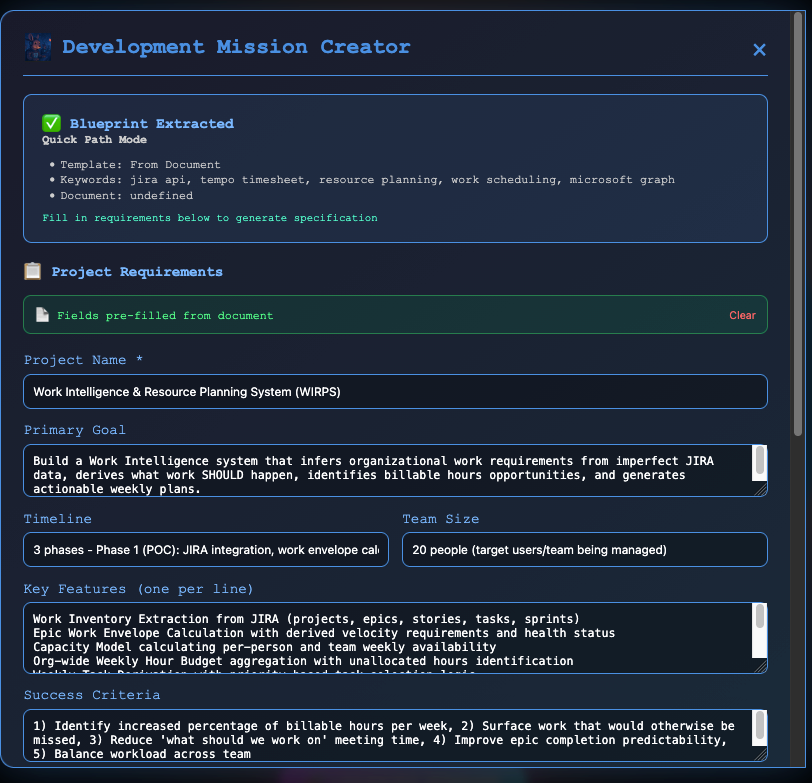
The Principal opens Big Bang Epic Creator and pastes the specification. The specification at this point is the classified output from Monday’s Meeting Intelligence, refined slightly, not rewritten. Big Bang decomposes it. Phases. Work units. Functional requirements. Acceptance criteria. Architecture diagrams rendered as Mermaid, one per phase. Gaps flagged inline where the AI could not answer from the input alone.
The Principal reviews the gaps. She answers some of them from memory. She pings the client for answers to the rest, with specific questions the client can answer in minutes. No meeting required. The gaps close by Tuesday afternoon.
By Tuesday evening the epic is unleashed. GitHub issues created for each phase. JIRA tickets mirrored. The architecture diagrams are in the repo. The whole build is described, reviewable, and ready.
Wednesday: the build
Miracle Mode runs overnight.
By Wednesday morning, the phases have executed. Each phase ran in an isolated worktree. Each phase was analyzed with a smart prompt, implemented by Claude Code, committed to a feature branch, and handed to the Forge for verification. The Forge booted each phase, caught the failures the AI introduced, attempted fixes, and logged the ones it could not fix so the Principal can look at them over coffee.
On Wednesday afternoon the Principal reviews the Miracle run. Most phases completed cleanly. A few have stuck-phase flags. She opens the Forge logs, reads the actual errors, and fixes them in minutes because she can see exactly what went wrong. The Forge is not a unit test suite. It is an operational reality check. It boots the system, tries to use it the way a user would, and reports what broke.
By Wednesday evening the full system builds, deploys to staging, and passes the Forge. The cosmic emissions for the run are searchable. The Principal can ask the RAG Companion why the database schema chose UUIDs over integers and get the exact commit and reasoning from Tuesday’s Miracle log.
Thursday: the ops
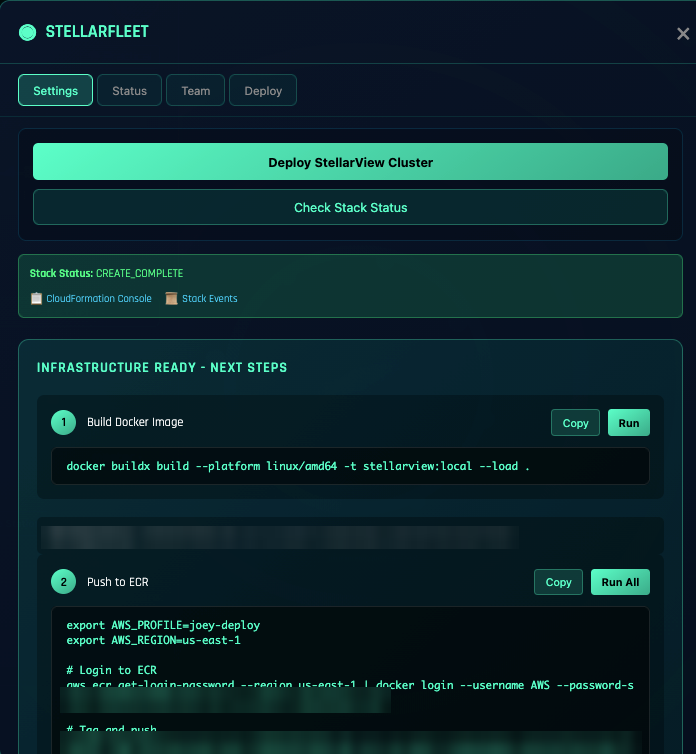
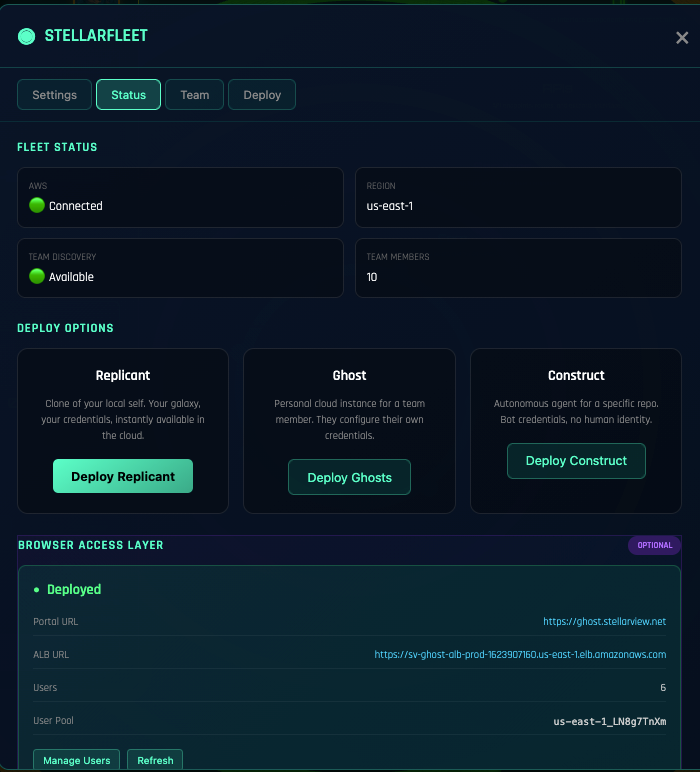
Fleet provisions a Ghost instance on Thursday morning. The Ghost is an ephemeral compute surface, cloud-resident, observable, and scoped to this engagement. The system deploys to the Ghost. Telemetry starts flowing. The Principal configures the Transporter Room access so the client can reach the running system through a Cognito-authenticated gateway.
The cosmic emissions timeline fills out as traffic starts hitting the Ghost. Real requests. Real errors. Real performance data. The Principal watches a few hours of actual usage, tunes the obvious issues, and documents the operational shape so the team who will eventually hold this system has a narrative to read.
Fleet governs the Ghost from Day One. There is no “later we will move this to production.” This is production. It is ephemeral in the sense that Fleet can tear it down and rebuild it from the repo at any time. It is permanent in the sense that it is the surface the client will actually use and the team will eventually run.
Friday: the reveal
Friday morning the client opens the Transporter Room. The Principal walks them through the running system. Not a staging environment. Not a demo environment. The same instance that will become their operational reality. The client clicks around. They find three things they want changed. The Principal queues the changes as a mini-epic, Big Bang decomposes them into five work units, and the Miracle is scheduled to run that night.
The client asks when they will see the changes. The Principal says Monday.
Five days earlier, the client was describing a problem into a Zoom camera. Five days later, they are clicking through a running system and scheduling its first iteration. The proposal did not exist as a document. The statement of work was a single page. The architecture review was the Mermaid diagrams on Tuesday. The kick-off was the Vibe session on Monday afternoon. Every meeting the old cycle had is folded into the work itself.
That is the week.
What dissolved, what stayed
Five things collapsed:
The requirements document is now a live specification inside Big Bang, refined through gaps and answers, not a PDF that nobody reads after it is signed.
The architecture review is now the Mermaid diagrams embedded in each phase, readable by the practitioner and by anyone else in the room, updated as the build proceeds.
The project plan is now the phase grid in Big Bang, visible, executable, reflowable when scope changes.
The developer handoff is now the Miracle execution, which does not have a handoff because the same mission context carries from phase to phase.
The deploy ceremony is now Fleet provisioning a Ghost, which is not a ceremony, it is a command.
Three things stayed:
The client conversation stayed, because the human who has the problem still has the problem, and no tool can substitute for listening.
The human review stayed, because every phase of the Miracle has a human gate between completion and publish, and that gate is where judgment lives.
The working system stayed, because Step 1 demos without Step 2 systems are where the old cycle wasted its time. The new cycle wastes none of that time, because the system has to work by Thursday or the Principal does not meet the client on Friday.
The economics flip
The old cycle burned money in the pre-work. Talk, search, scope, price, negotiate, sign. Six weeks of effort before a single line of code. For a 2-week build, the pre-work was 300% of the work. For a 3-month build, the pre-work was 50%. Either way, the margins died in the scoping, because the scoping was never billable the way the building was.
The new cycle inverts that ratio. The Principal’s time on Monday is the sell, because by Monday evening the client has seen a running system that uses their own language and addresses their own pain. The rest of the week is compounding value: Tuesday shapes it, Wednesday builds it, Thursday operates it, Friday reveals it. Each day multiplies Monday. No week is spent waiting for the previous week to finish.
A four-person team on this cycle books more billable hours in a week than a twelve-person team books in a quarter under the old cycle. The twelve-person team is not less skilled. They are paying a handoff tax the four-person team does not pay.
The week is a feature of discipline, not of tools
The first time a practitioner reads this walkthrough, they see the tools. Vibe Creator. Big Bang. Miracle. The Forge. Fleet. Transporter Room. They think: the week is possible because of the tools.
That is half right. The tools are necessary. They are not sufficient.
The week is possible because the Principal does not pause between phases. She does not hold a meeting to transition from Vibe to Big Bang. She does not schedule a review to transition from Big Bang to Miracle. She does not convene a stand-up to check on Miracle’s overnight run. She operates. Each phase flows into the next because she is the same person throughout, holding the same context, refining the same signal.
A team that tried to compress this week by parallelizing roles across specialists would add back the handoffs the week was designed to eliminate. The discipline is continuity of attention, not speed of typing. The tools remove the friction. The Principal removes the waiting.
That is why the week is a feature of discipline. It is also why the week is not yet universal. Most teams are still organized for the old rhythm. Specialists. Handoffs. Committees. They can adopt the tools without adopting the practice, and when they do, the week extends back out to six weeks, because the meetings absorb the time the tools gave back.
The question to ask next Monday
If your team is staring at the old rhythm and wondering why the AI projects keep stalling, the question is not “which tool should we buy?” The question is:
What would it look like if one person held the work from talk to running system, and every tool existed to remove friction from that person?
That is the week. The tools are downstream of the answer. StellarView is how the answer becomes operable at scale, across many engagements, with a portfolio of galaxies, fleets, and skills compounding across every run.
But the answer starts Monday morning, with one Principal, one conversation, and one refusal to wait for next week to begin.