A language is forming.
Right now, in the gap between what a Principal can build and what a Principal can hand to anyone else.
The Modern Principal works from above. Agents do the work of the lifecycle, and by the end of the sprint the thing exists and runs. The old grief, the idea thinning between the having and the making, is over. The making got cheap.
But a new thinning took its place. It is quieter, and it comes later. It happens between knowing and saying. You can build the thing in an afternoon and still not own a word for it that survives leaving your head. You point; the other person nods and hears something else. The system is whole in one mind and a rumor in every other.
That gap is a language problem. And a language is forming to close it.
The terminology is ridiculous
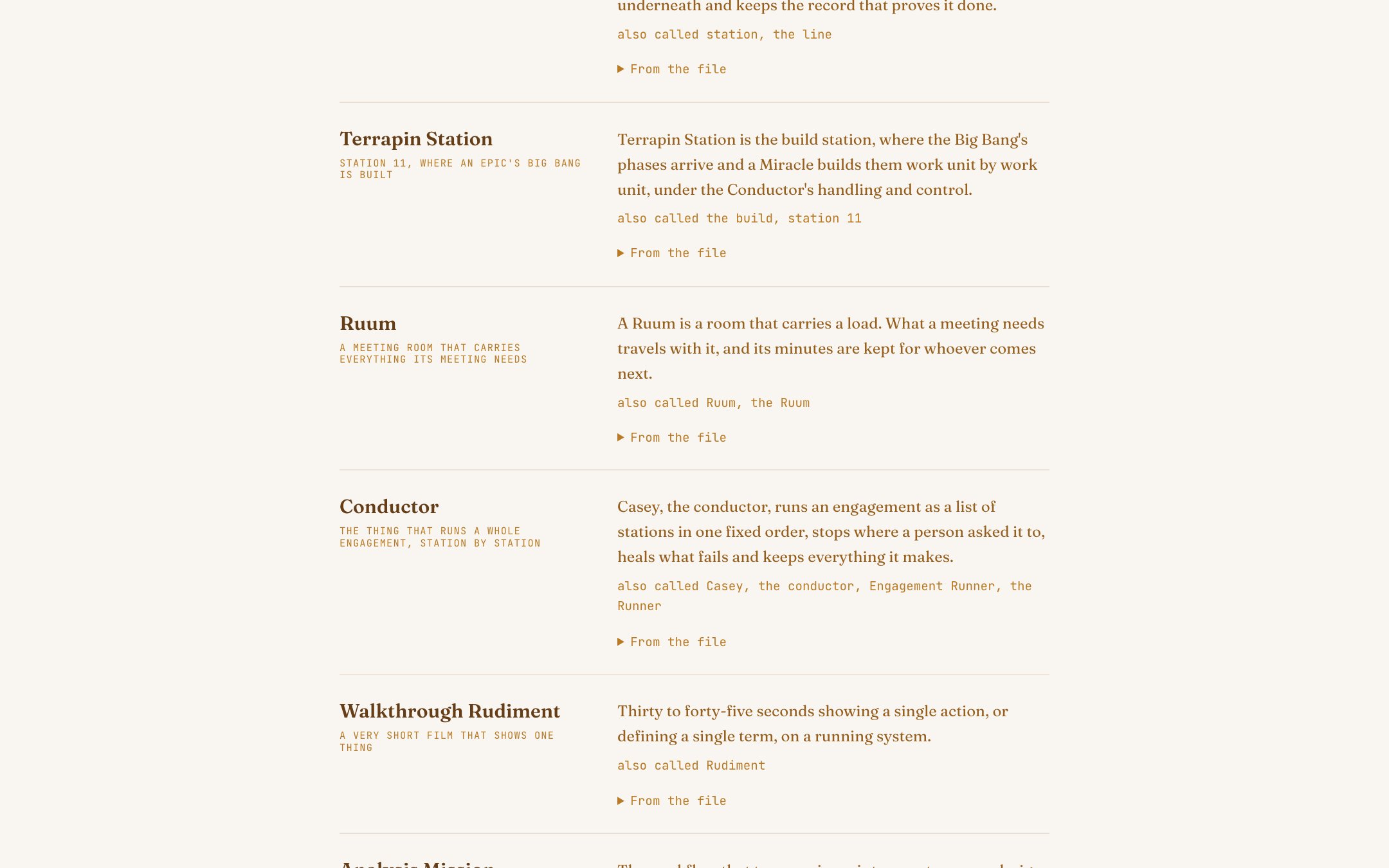
StellarView speaks in galaxies and constellations. Newcomers think one of two things: this is ridiculous, or this is ridiculous and I love it. Both are correct, and we laugh at our own names too. But every one of them is dead serious underneath. Here is what each one means:
RidiculousDead serious
Repository or project.
Where an epic is built.
The thing that runs a whole engagement, station by station.
A meeting room that carries everything its meeting needs.
A question the plan cannot answer on its own.
What each AI call carried, and what it cost.
A machine a StellarView is slung to.
Send a StellarView somewhere.
Reaching a machine without opening it.
Destroying an idle machine without losing anything on it.
Boot the whole app from clean, and run every gate.
People and agents working one part of the SDLC together, on the record.
A sprint ceremony held by the agent seats, every claim citing the record.
Click a name for its full entry, and its short film where one exists.
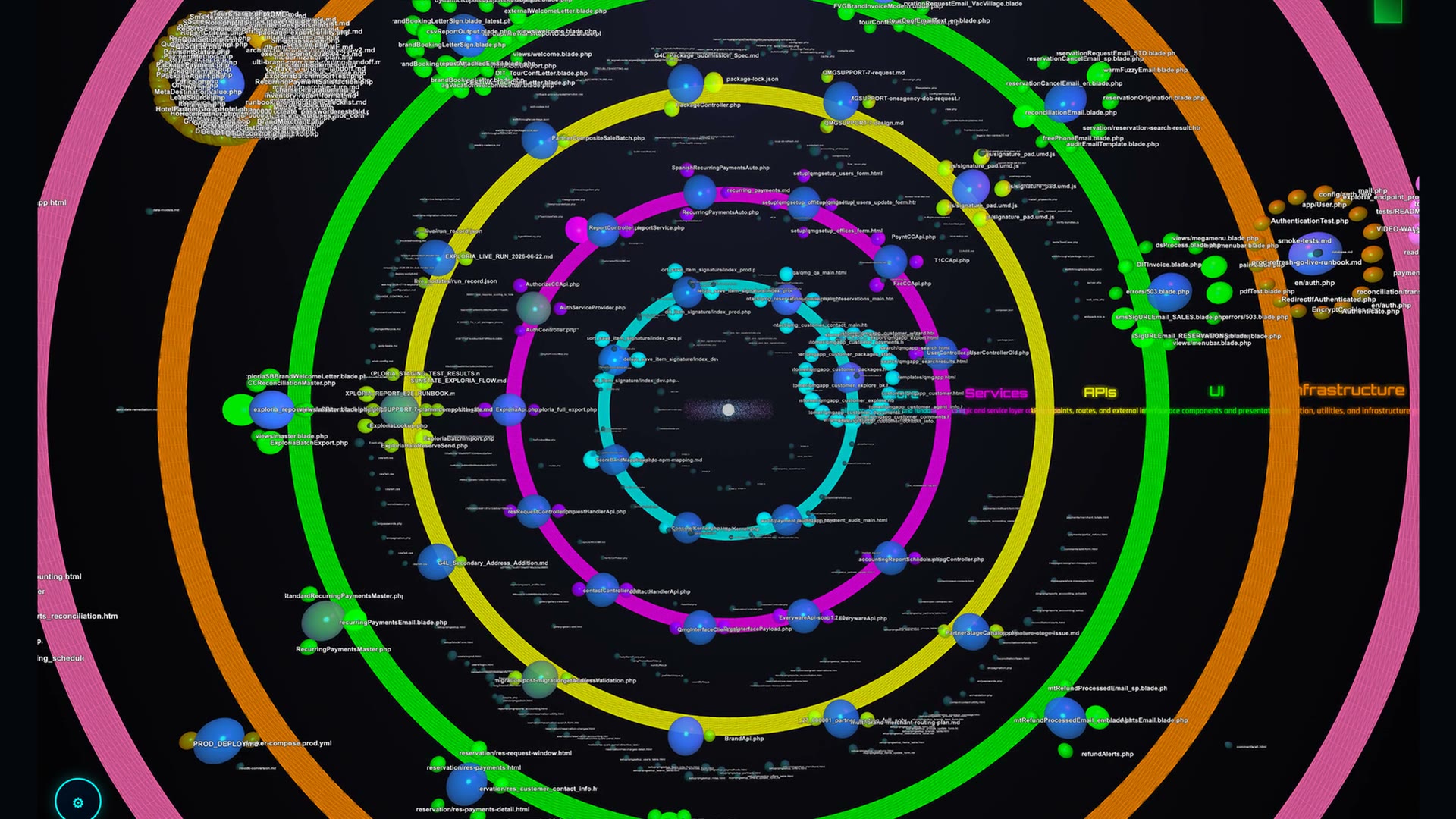
The names are not decoration. A metaphor compresses a whole system into one image the listener already understands. Call a codebase a constellation and someone who has never opened the repo can already see it: layered, navigable, far off but reachable. That is a lesson taught in a single word. The terminology is ridiculous. The system it describes is rigorous.
Until there are better terms, and until our industry agrees on new practices for the SDLC, we are trying to lead that charge, so that we can all have the same metaphors in our heads.
This is what a curriculum is. Not a manual. A set of names dense enough to carry, each one a lesson you can hand to someone else whole.
Darmok
In “Darmok,” an episode of Star Trek: The Next Generation (Menosky 1991), Captain Picard, Jean-Luc, is stranded with a Tamarian captain, Dathon, whose every sentence the universal translator renders perfectly and leaves him understanding nothing. Darmok and Jalad at Tanagra. Shaka, when the walls fell. Temba, his arms wide. The Tamarian tongue was not built of words. It was built of stories: each phrase a whole narrative the speakers already shared, invoked to carry a concept too large for a word. “Shaka, when the walls fell” is not “failure.” It is failure with a myth wrapped around it: the shape of it, the grief of it and the warning in it, delivered in three syllables to anyone who holds the story.
Darmok and Jalad at Tanagra.
That is what a name does at full strength. It is a placeholder for something larger: an idea, an image even when there is no picture, a whole curriculum, folded into something you can say in a breath. “The Big Bang” is a phrase at Tanagra. So is “Casey.” So is rarum carum. Each is a story the practice already shares, invoked to move a concept that would otherwise take a page.
And there is the catch the episode is really about. The phrase only works if the story is shared. The translator had every word and missed all the meaning, because the meaning lived in the myth, not the vocabulary. A name is worthless to anyone who does not already hold the story behind it. This is why a curriculum is not a glossary. It is the shared stories that make the short phrases land, and why, when everyone invents their own, no one can hear anyone.
The film Enemy Mine (Petersen 1985), from Barry B. Longyear’s novella (Longyear 1979), tells the same story from the other side. Louis Gossett Jr. plays Jeriba Shigan, a Drac. He and Willis Davidge, a human pilot, shoot each other down in a war between their peoples and are stranded together on a hostile planet. They learn it the hard and only way: enemies, surviving just as far as each can speak the other’s tongue. Language is not decoration on the relationship. It is the bridge, and sometimes the only one, across the widest distance there is.
Where the cosmos runs out
Every lens has a focal plane, and past it the picture blurs. The cosmos is superb at exactly one family of things: structure, scale, navigation, the awe of bigness. That is why it worked.
Read · Galaxy, in the vocabulary
It is useless at another family. Space has no people in it. It has no cost; it is infinite and free, which is precisely the wrong instinct for work that is metered by the token. Distance in space is only bigness, and cannot hold the cost of one mind reaching another. Light is only travel-time, and cannot mean insight. A mind is not a star. Reality is not a map of stars.
Name the things the cosmos cannot hold and you have named the whole present: humans, distance, light, minds, cost, reality. The metaphor that taught us to see the system cannot teach us what the system costs, or who pays, or what it is like to be the person on the other end of it.
A good curriculum does not throw out a lens that blurs. It adds the lens that focuses where the first one could not.
The fixed point
Here is why the Principal, and a growing number of people, reach for Latin.
Latin is useful because it is dead. A living language drifts under your feet; its words mean something new in ten years. Latin’s do not move. For a standard, that is the entire point: you want the anchor fixed so the meaning riding on it can stay alive. Law and medicine kept it long after they stopped speaking it, and so did the naming of living things.
And it compresses the way metaphor does, but with a spine. Rarum carum, what is rare is dear, is a complete argument in two words; the Romans already carried it as omne rarum carum. Inflection drops the scaffolding and keeps the load. It is ownerless, so everyone meets on neutral ground, no home-team advantage. It is root stock rather than brand names: new terms compose from known roots, so a coinage is half-understood on sight. And its teaching unit is the sententia, a whole doctrine compressed into one balanced line you invoke by name.
Omne rarum carum.
This is not nostalgia. It is the move the sciences made during their own explosion of new concepts: when invention outruns language, you reach for a fixed anchor. Linnaeus did not make biology less alive by fixing Homo sapiens under the mess of actual organisms (Linnaeus 1758). He made the aliveness shareable. AI is at that moment now, and mostly missing it.
Babel
Because look at what is actually happening. Everyone is minting their own AI. Their own prompt-dialects, their own coined terms, their own private words for the same few new things. That is not a language explosion. It is Babel, a thousand vocabularies that cannot compose, invention that fragments understanding instead of compounding it.
A private vocabulary makes you fast alone. A shared vocabulary makes a firm compound. The difference between the two is a standard, a method that keeps everyone’s coinage interoperable. That method is what PractiCAI is for. Not a framework, not a product. The agreement that lets a name minted in one head still spend in another.
Without it, every practitioner rebuilds the dictionary from scratch, and none of the dictionaries agree. With it, the practice compounds. Not in theory. In names.
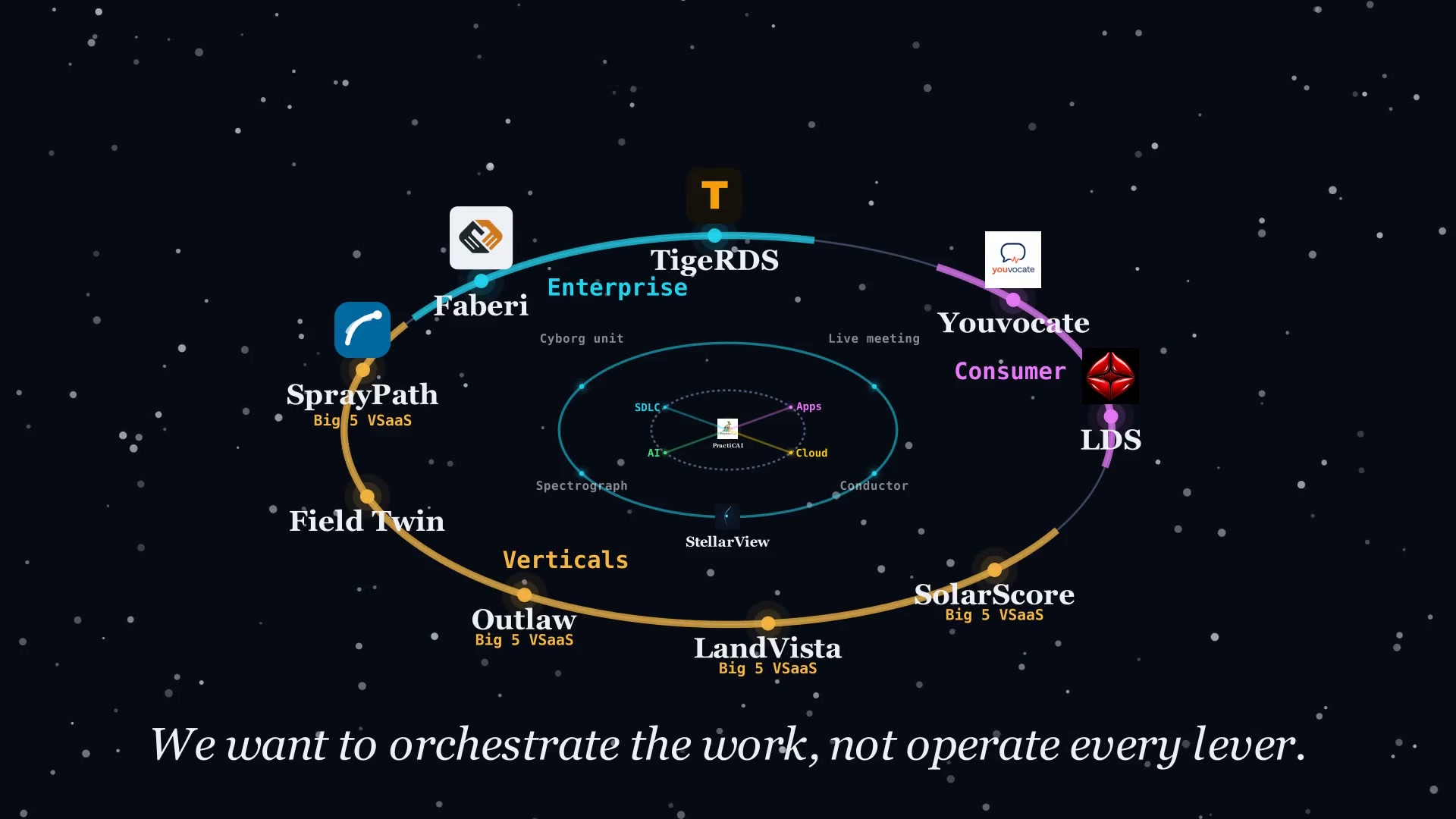
Fixed names, living meaning
Nomina fixa, sensus vivus.
The answer to “the cosmos cannot hold cost” is not one replacement metaphor. It is a portfolio of them, each carrying what it is good at, over one shared grammar, with Latin as the fixed handles underneath:
- The cosmos carries structure and scale. Keep it.
- The barrel carries cost and time: value that comes only from waiting, the opposite of the free-and-infinite instinct space gives you.
- The formation carries roles and delegation: who touches what, and why you never send the one who reads the field to also block.
- The dojo carries practice: the craft that compounds while the tools churn. It is where The Discipline is drilled.
- The guild carries transmission: how a craft moves from one person to the next.
Each domain is a living language, allowed to grow and drift and get colorful. Latin is the spine beneath them that does not move, so a term stays pointable across dialects. The metaphors teach; the Latin tags hold.
And for the six things the cosmos dropped, the lexicon can name them outright:
- Mens, non stella: a mind, not a star. The unit was never a point of light.
- Non lux, sed lumen: insight, where the cosmos only had light. Photons are not understanding.
- Pretium intervalli: the cost of the gap. Distance is priced, and paid.
- Res, non stellae: reality, not stars. The work is matter, not empty space.
- Nomen non res: the name is not the thing. A guardrail against believing your own metaphors.
- Fige nomen, solve sensum: fix the name, and you free the meaning.
Six phrases at Tanagra. Each is small enough to say in a breath and large enough to carry a whole lesson out of the room.
A name keeps its source
A fixed name is only half the spine. The other half is where it came from. In StellarView every term a team uses is shown with its source. Scrum comes with the Scrum Guide (Schwaber 2020). A practice of ours comes with the file that makes it real. A team’s own methods are shown the same way, so its vocabulary becomes the bridge between how it already works and how the agents work.
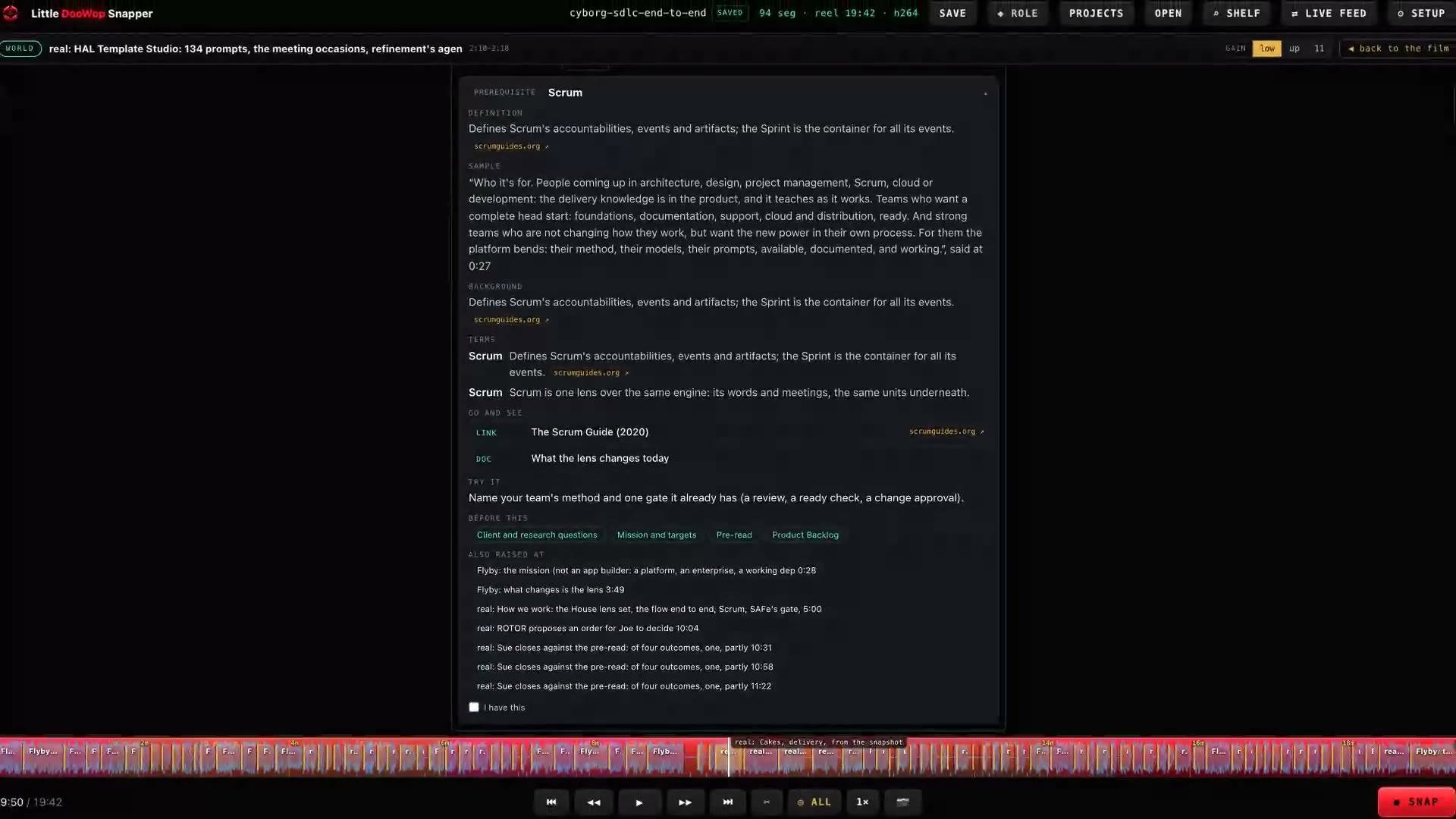
Read · what a meeting leaves behind
How a World teaches
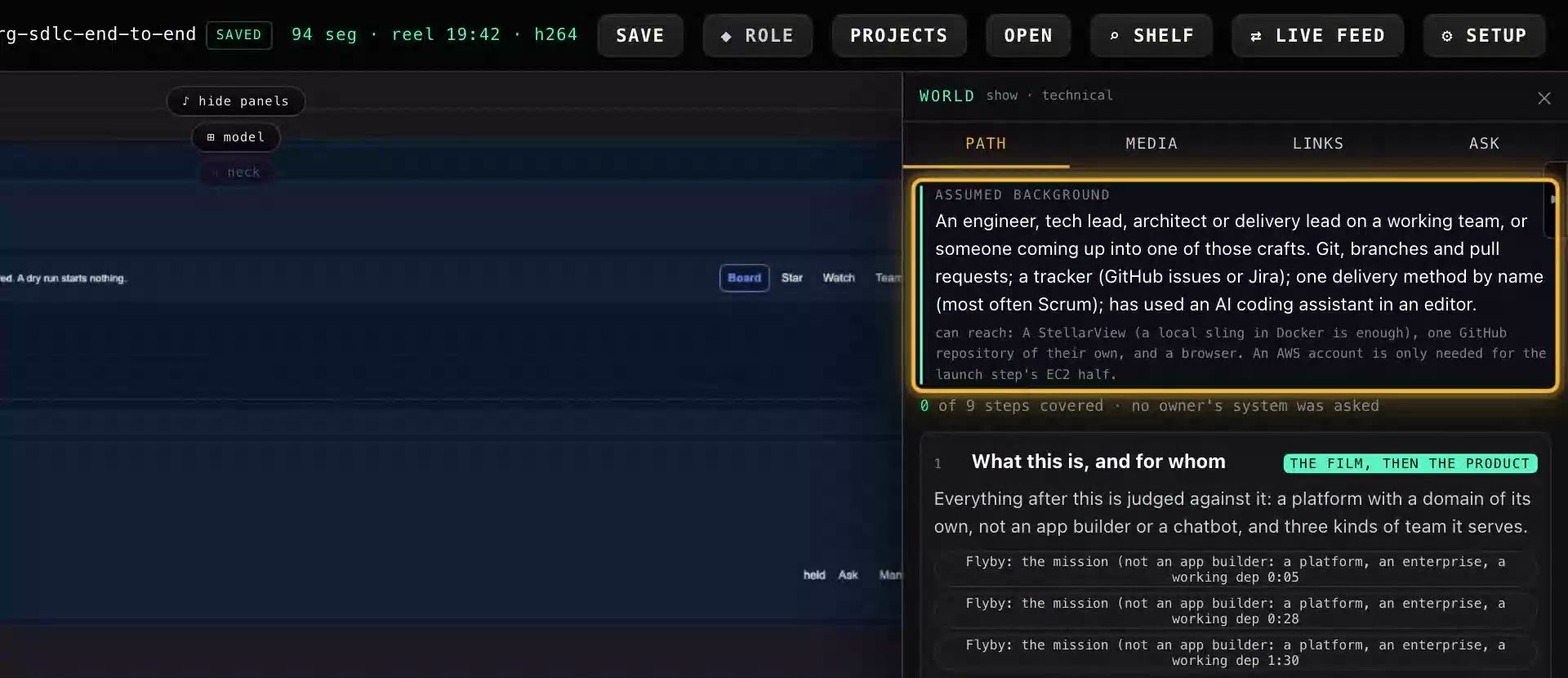
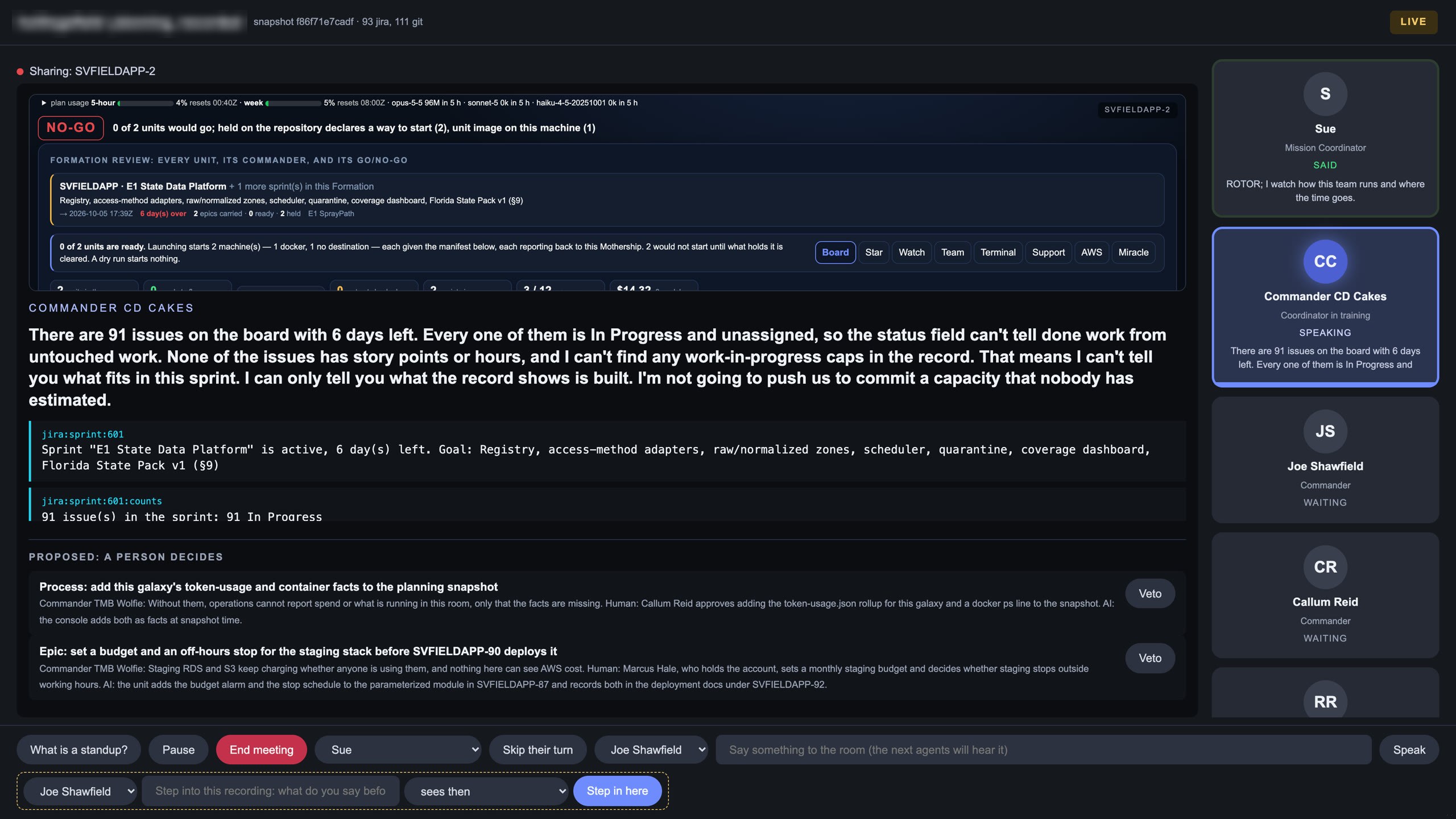
A curriculum also needs a way to be taught. We record our meetings, and Little Doowop Snapper (LDS) turns a recording into a film with the whole record underneath it. Each film becomes a World: a place to read what was said, see what it cited, and learn from it.
A World teaches along a path written for a stated viewer, for example an engineer or a delivery lead who has used an AI coding assistant. The path has steps, and each step ends on a checkpoint: a question the viewer answers before going on. At the end, the viewers test themselves on what it taught.
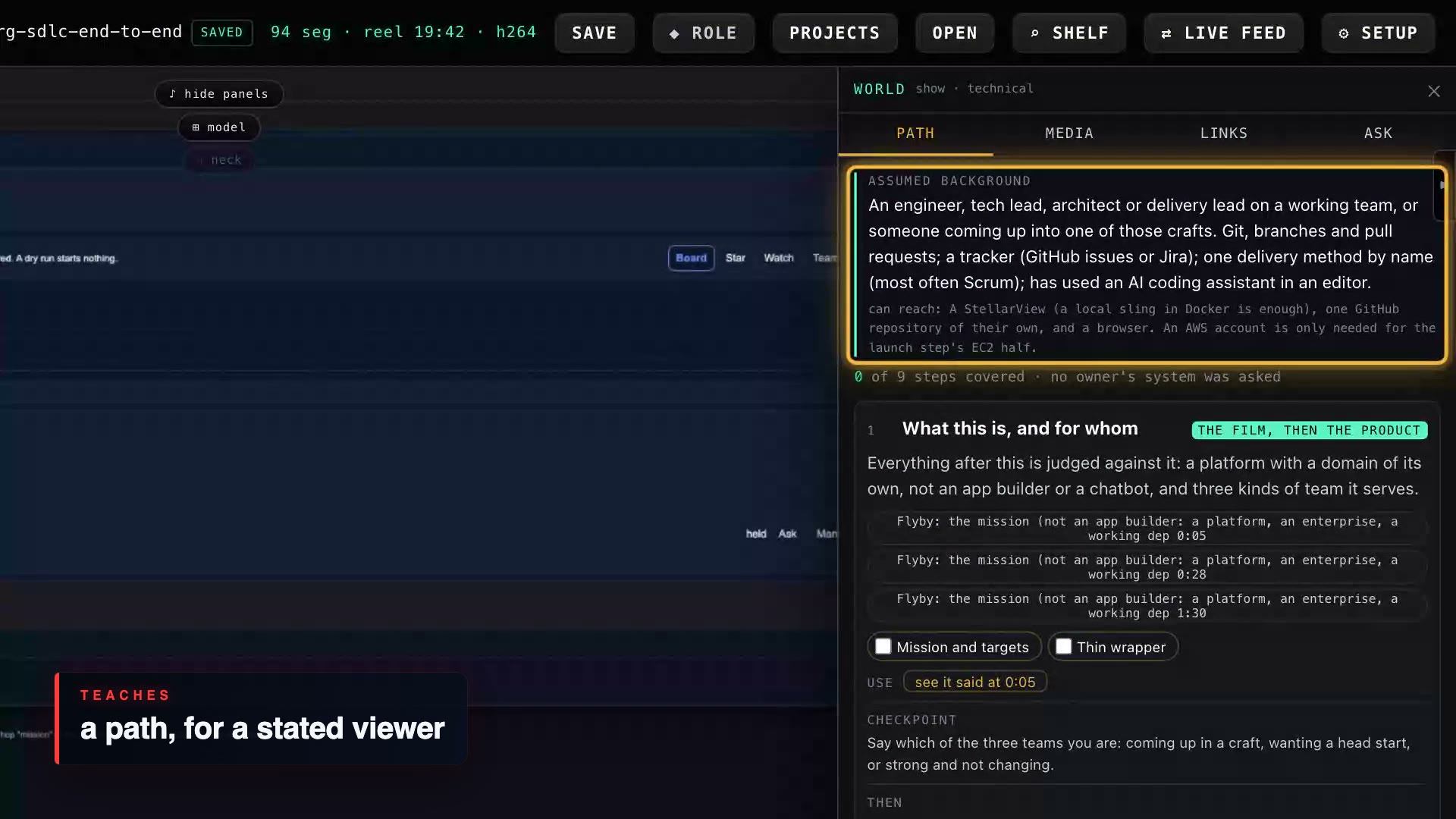
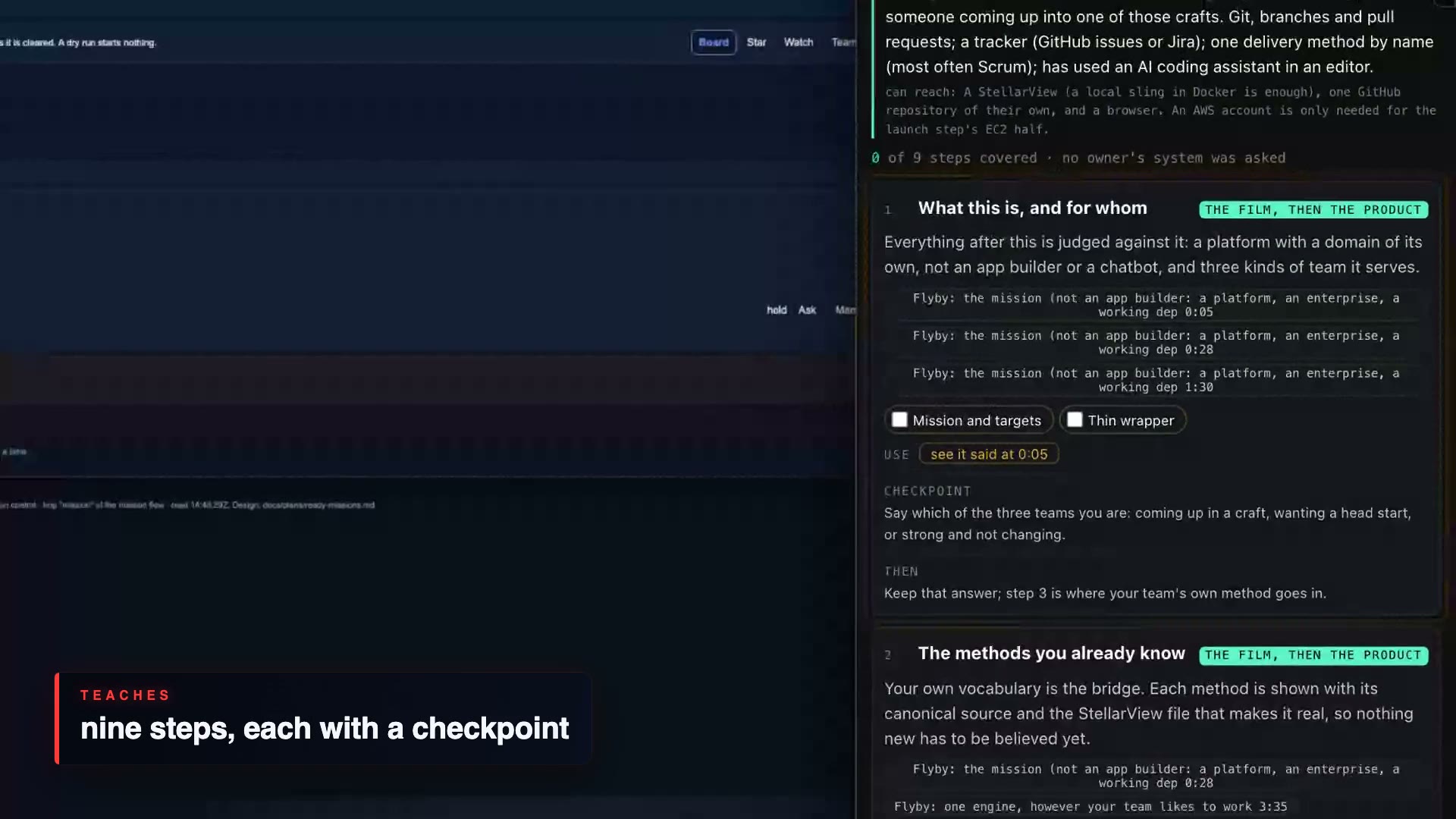
Read · what a meeting leaves behind
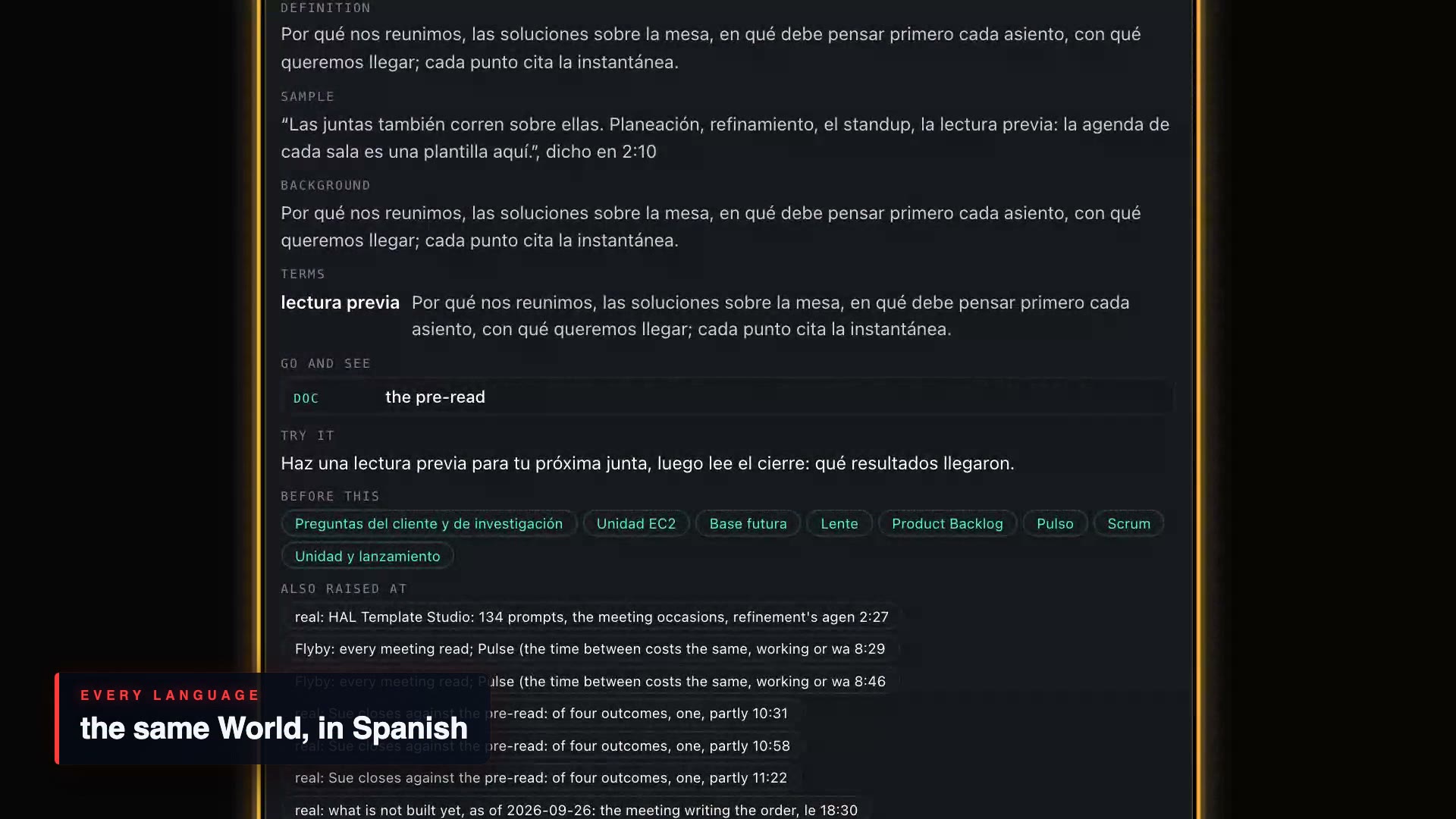
A language that is shared has to survive translation. The same World can be read in Spanish: the English topic turns Spanish on screen, and each translated term still points to its source.
Read · what a meeting leaves behind
How people catch up
This is the part that matters beyond StellarView.
AI now generates concepts faster than human language can name them. That is the real reason people feel behind. The tools are powerful, and we have no words to hold what they do, and you cannot hand someone a thing you cannot name. You do not catch up by reading more. You catch up by naming better.
A coined name is a cache. You pay once to mint it, the hard thought, the right image, the line that finally lands, and then everyone spends it cheaply, forever. That is the human side of the token economy this whole practice already lives by: dense names are cheap names. Mint the lexicon once; pour it out for free after.
And there is one thing here that needs no coined name, because it makes its own argument: the running system. Res ipsa loquitur, the thing itself speaks. A build you can boot ends a debate that a thousand names could not. So the lexicon rests on a floor: you name what you cannot yet show, and you show what no longer needs naming. The build has the last word.
So the Modern Principal’s work is larger than it first looked. It is not only to hold the full picture. It is to name the picture, in language fixed enough to survive leaving one head, so that someone else can hold it too. That is what turns a practitioner into a practice, and a practice into a profession.
The language of the enemy
There is one more distance this language has to cross, and it is the widest yet.
The keyboard is going. The typing is already abstracted; the craft is what surfaced, and the practice has said so from the start. What replaces the keyboard is not a faster keyboard. It is language itself. You say the thing; the machine makes it. Tomorrow’s interface is a sentence.
So the sentence had better be precise, and it had better be shared. An interface made of words is only as good as the words: vague language builds vague systems, and private language builds systems no one else can touch. This is where the whole argument lands. When words become the interface, naming is no longer decoration. It is engineering.
And the party on the other side of that interface is not human. It is the machine, the nearest thing we have to Gossett’s Drac in Enemy Mine: the intelligence we were taught to fear and now must learn to speak with. We are learning the language of the enemy, the way the two castaways did, and we are finding what they found, that the tongue you cross the gap in is the thing that turns an enemy into kin. We do not learn it to surrender, and we do not learn it to bark at a tool. We learn it to make a human connection across the widest distance there has ever been, and through that connection to reach a higher order of making than the keyboard ever allowed.
The curriculum is alive because it keeps being coined. It holds because the spine is fixed.
What does not automate
It helps to be plain about which part of the work just left.
The producing left. The document, the boilerplate, the first draft of a test, the name typed into a file: these are made now for almost nothing, and the skill of making them, which once took years, is no longer scarce. Documentation went first, because a document is the purest case of produce-the-artifact. If a person’s value was that they wrote good docs, that value is already gone, and some have not noticed.
What did not leave is the judgment of whether the thing is true. A generated document is a claim. Whether it says the load-bearing thing, whether it is honest about what is not yet done, whether a number on the page was flattered by an easy win: none of that lives in the producing. It lives in the reading, and the reading was never the same skill as the writing.
So the role does not shrink as the tools grow. It moves. The work is no longer to make the artifact. It is to decide whether the artifact is true, and to know what done means when the machine reports done. That part does not automate, because the machine has no stake in the answer.
Res ipsa loquitur.
There is an arbiter that settles it without a word. Res ipsa loquitur: the thing itself speaks. A running system does not care how well its documentation reads. Deploy it and use it, and it tells you what was true. The producing is cheap. The judging is the work. The build has the last word on both.
The handover
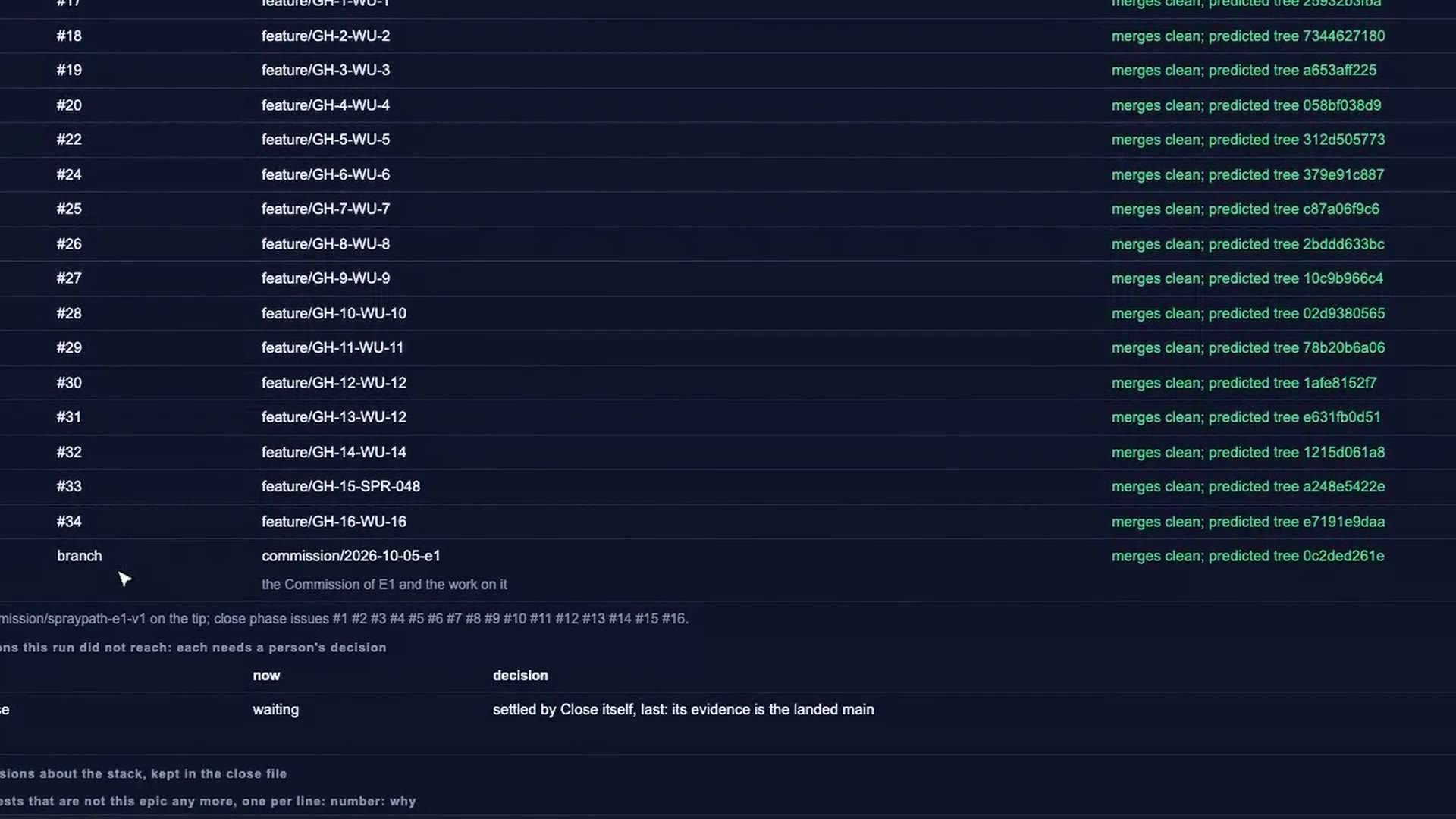
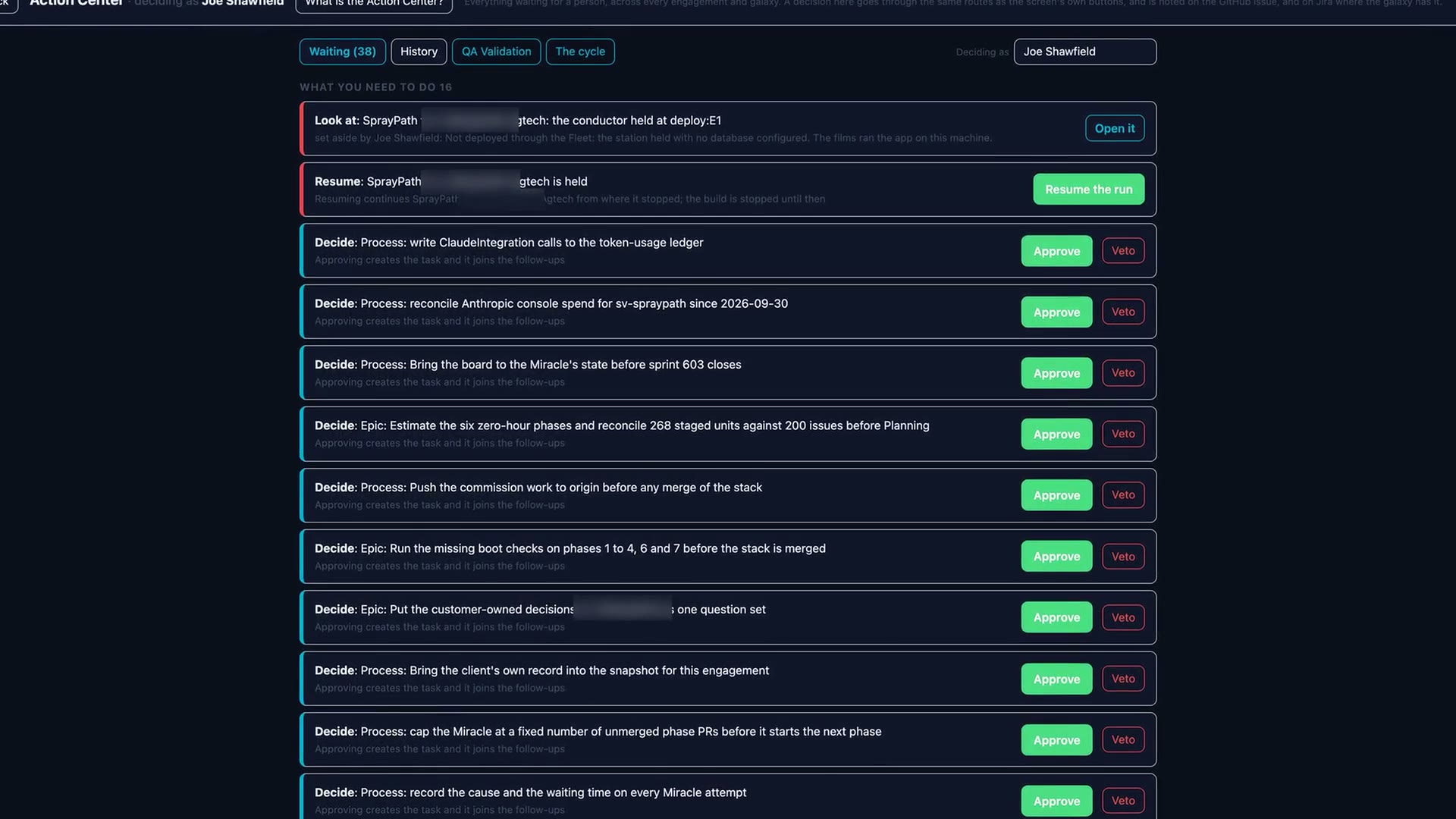
A curriculum ends in a handover. What the team receives is the repository, the record and the films, and the cloud it runs in. The record shows how each piece was made: every merge, and every decision a person made at a gate. The team learns the product from that record, in the same meetings it already holds, and runs it from there.
Read · a launch engagement, handed over
Enter the language
The companion essay, The Modern Principal, names the practitioner: who they are, and why the role is forming now. This one names their tongue.
- If the terminology sounds ridiculous: good. Read The Discipline. It shows the rigorous work behind the names.
- If you want the map before the philosophy: read the vocabulary. Every term is there, with what it means and where it comes from.
- If you want to see a World teach: read what a meeting leaves behind.
- If you are already coining your own: you are doing the work. The only thing missing is the spine, a fixed name under each living one, so what you mint can be shared instead of stranded.
The making is cheap now. The naming is the work.
References
- Carl Linnaeus. 1758. Systema Naturae, 10th edition. Laurentius Salvius, Stockholm
- Barry B. Longyear. 1979. “Enemy Mine.” Isaac Asimov's Science Fiction Magazine. The novella the film was made from
- Joe Menosky and Philip LaZebnik. 1991. “Darmok.” Star Trek: The Next Generation, season 5, episode 2. Paramount Domestic Television. Teleplay by Joe Menosky, story by Philip LaZebnik and Joe Menosky. First aired September 30, 1991
- Wolfgang Petersen. 1985. “Enemy Mine.” Twentieth Century Fox. Film, directed by Wolfgang Petersen, screenplay by Edward Khmara, starring Dennis Quaid and Louis Gossett Jr
- Ken Schwaber and Jeff Sutherland. 2020. “The Scrum Guide.” https://scrumguides.org/scrum-guide.html