
The sprint planning, on the rings
Part 2 of the JOEY Mob. Part 1 was Roger Rodger’s first afternoon. This is his second day: the team plans its own sprint.
This is how we run. A standup of people and agents, on StellarView’s own rings, planning real work toward a real release. The voices are synthetic and the lines are written by an agent; the badge in the corner says so. What is shared on the stage is not written by anyone. It is the product, and the records behind it, read the day the film was made.
The board, built before the meeting
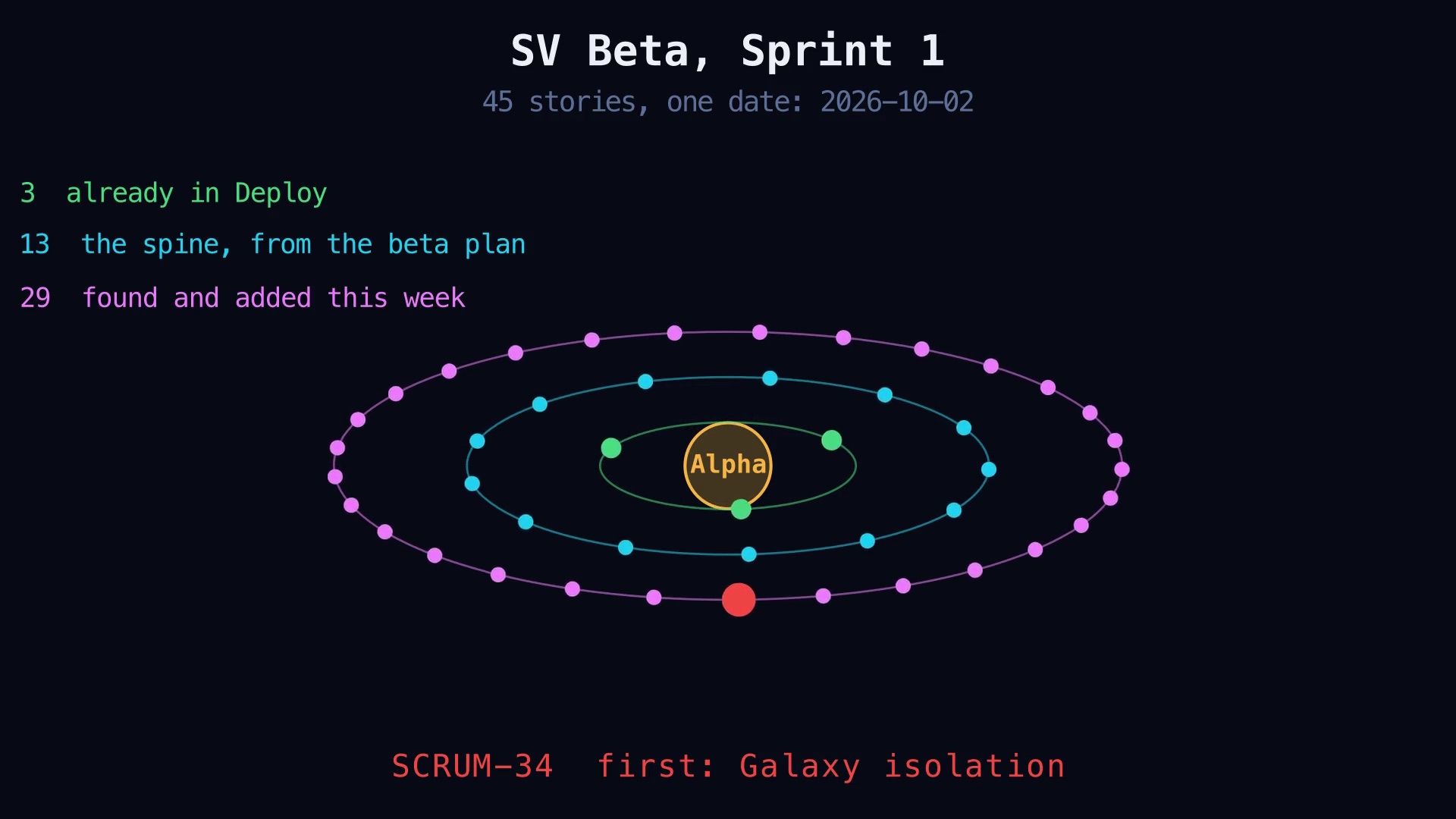
Sue’s job before a sprint planning is the board. The night before, she made one: the sprint “SV Beta, Sprint 1” on our own Jira, its goal, its dates, its stories, all created through StellarView. Until that night StellarView could read a sprint and move work into one, but could not make one. Now it can, and it closes the stale one too.
The meeting opens on a Flyby of that board, drawn from Jira as it renders: 45 stories orbiting one date. 3 already landed, 13 are the spine of the beta plan, 29 were found or added that week. The first one taken, lit red, is galaxy isolation.
Reports from the field
The Commanders check in on what they own. The hospital data center’s drawings are made and not yet behind a password. TigeRDS reads every database in the account and touches none of them; changing one needs a signature first. Slingshot’s Mob shows every sling on the laptop and in the account, and reads a working session without joining it.
Roger asks whether he can jump from that list straight into the cockpit. One click. He lost a week to that at his last job. So did everyone on the call.
The support desk, live
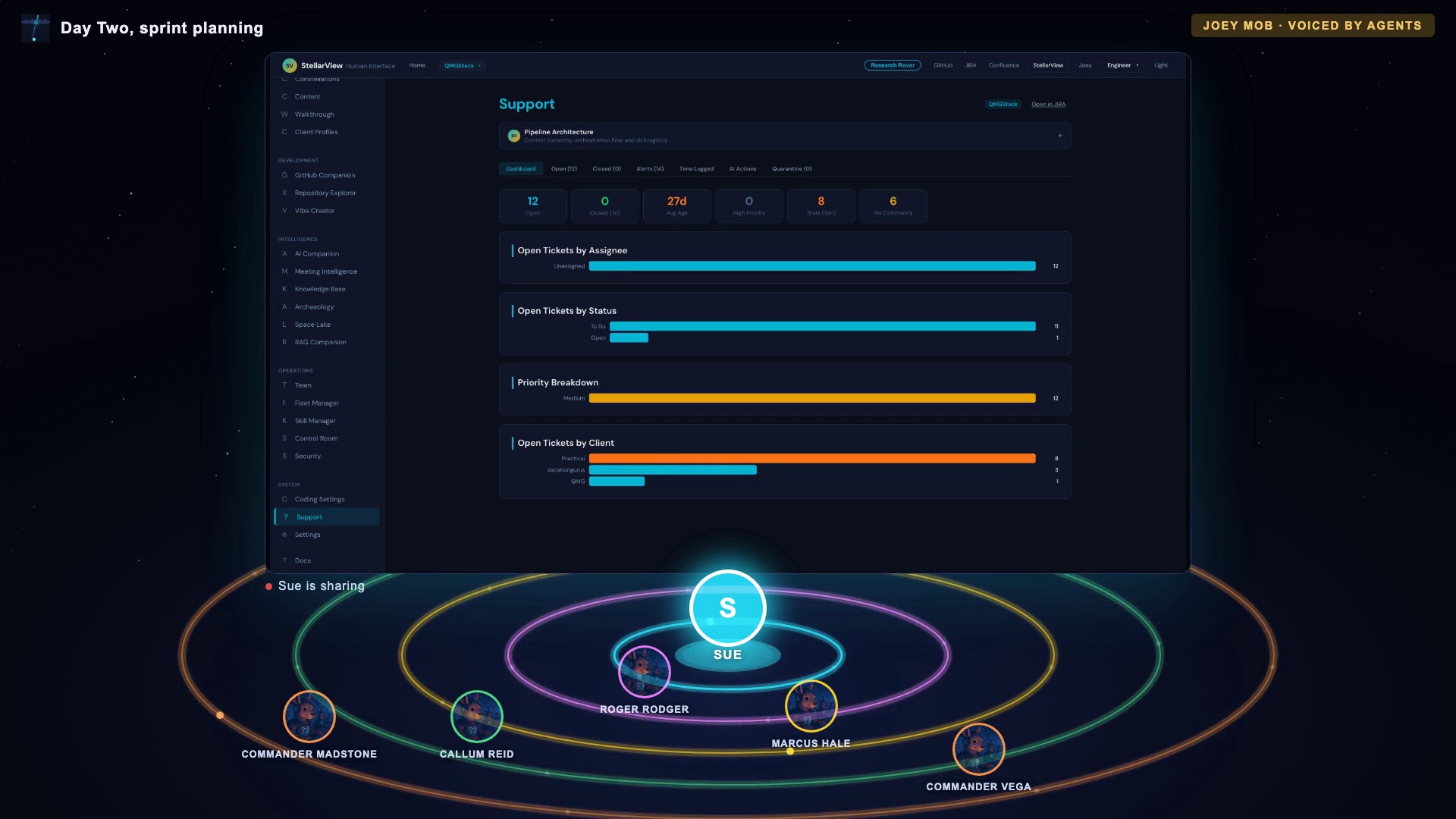
StellarView’s support flow is live, full cycle. Sue puts QMGStack’s desk on the stage: 12 open tickets, nobody assigned. She does not dress it up. That is ours to fix, and it is on the board.
Then Fathom. The last client meeting was flagged before anyone asked: an opportunity (permanent purchase links, no landing page needed), a risk (a launch going ahead before conversions are tracked automatically), and an issue (a lead list that held the buyers as well as the people who did not buy). The risk became a task on QMG’s own board the same night.
Apps, not brochures
Commander Madstone runs the vertical products, and shows the applications themselves: Coastal Critters’ platform, Re-Prise’s opportunity queue for real-estate management, Faberi’s landing-zone console. Re-Prise holds the Stellar MLS subscription; wiring the feed is next. Faberi’s website is still a holding page, so its web presence is on the board.
Marketing drops in
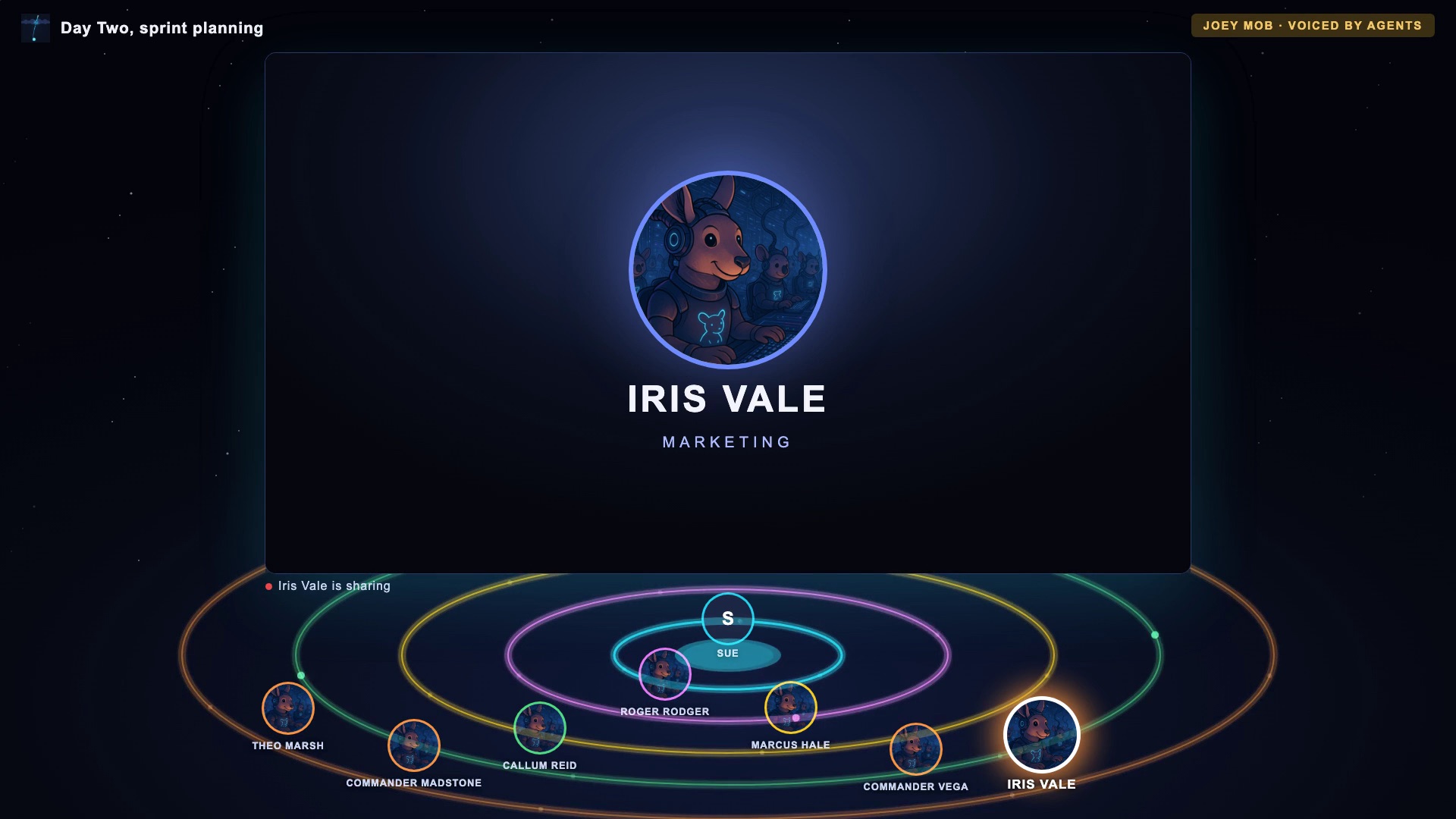
Marketing joins for its update and leaves when it is done. The call grows to eight on the rings and goes back to six. The update is a Flyby of how people reach us, read from the release desk’s own tables: 2 people asked, 5 grants issued, 3 emailed, 4 downloaded. One of the two who asked is our own test customer. Slung and supported come next. Show HN is on the launch path, and not before it is ready.
The pass, and the owners
Sue holds everyone, people and agents, to the record. Most of our galaxies name a wiki space that does not exist. Every build is meant to end with a support desk and a wiki; not yet.
Then the finding that explains a fear. Work had leaked between galaxies, and now we know why: 6 places in the mission code read the active galaxy from a cached file, and 28 fall back to StellarView’s own checkout when a mission carries no path. Isolation comes first, then StellarView becomes a galaxy of its own.
Six epics joined the board overnight, and each gets an owner out loud: the Consumer line, Faberi in Slingshot and on the web, TigeRDS wrapped for Slingshot, the free Library and the infrastructure it slings, the Snapper’s World merged into StellarView, and the team routine itself, run every night. Sue’s rule covers all of it: every product repackaged with current certificates, versioned the way the release desk grants it, reached from Slingshot.
Roger adds a gate before anyone asks him to: every mission says which galaxy it is in before it touches a file. He offers to make the ticket. It is already in.
What it is
A sprint planning that shows the whole house at once: the plan, the field, the desk, the customers’ path, the gaps, and who owns each one. Today an agent writes the lines. The same meeting, run by the Commanders as real agents on their real assignments, is on the board.
Credits
Voices, all spoken by piper: Sue (LJ Speech, public domain). Roger Rodger, Callum Reid, Commander Madstone, Iris Vale and Theo Marsh (CSTR VCTK Corpus, University of Edinburgh, CC BY 4.0). Marcus Hale (en_US joe, CC0). Commander Vega (Bryce Beattie, public domain).
Music: “Volatile Reaction” and “Movement Proposition”, Kevin MacLeod (incompetech.com), Licensed under Creative Commons: By Attribution 3.0 License, http://creativecommons.org/licenses/by/3.0/
Every name on the rings is a role, not a person.