
The standup that filmed itself
Part 1 of the JOEY Mob. StellarView Alpha, in five parts, delivered a solved application as an operated platform. This series is about the people, and the agents, who run it. Part 2 is the next day’s sprint planning.
A new Commander starts. Roger Rodger, Australian, databases and cloud. After lunch he is on a call with Sue, who coordinates the missions, and two Commanders who will be on his team.
The call is simulated. It says so in the corner of every frame. What is shared on it is not. Every screen is StellarView, captured the day the film was made, and every number said out loud is on a screen you can read. Eight minutes twenty four, 97 beats, five voices.
The rings, tilted
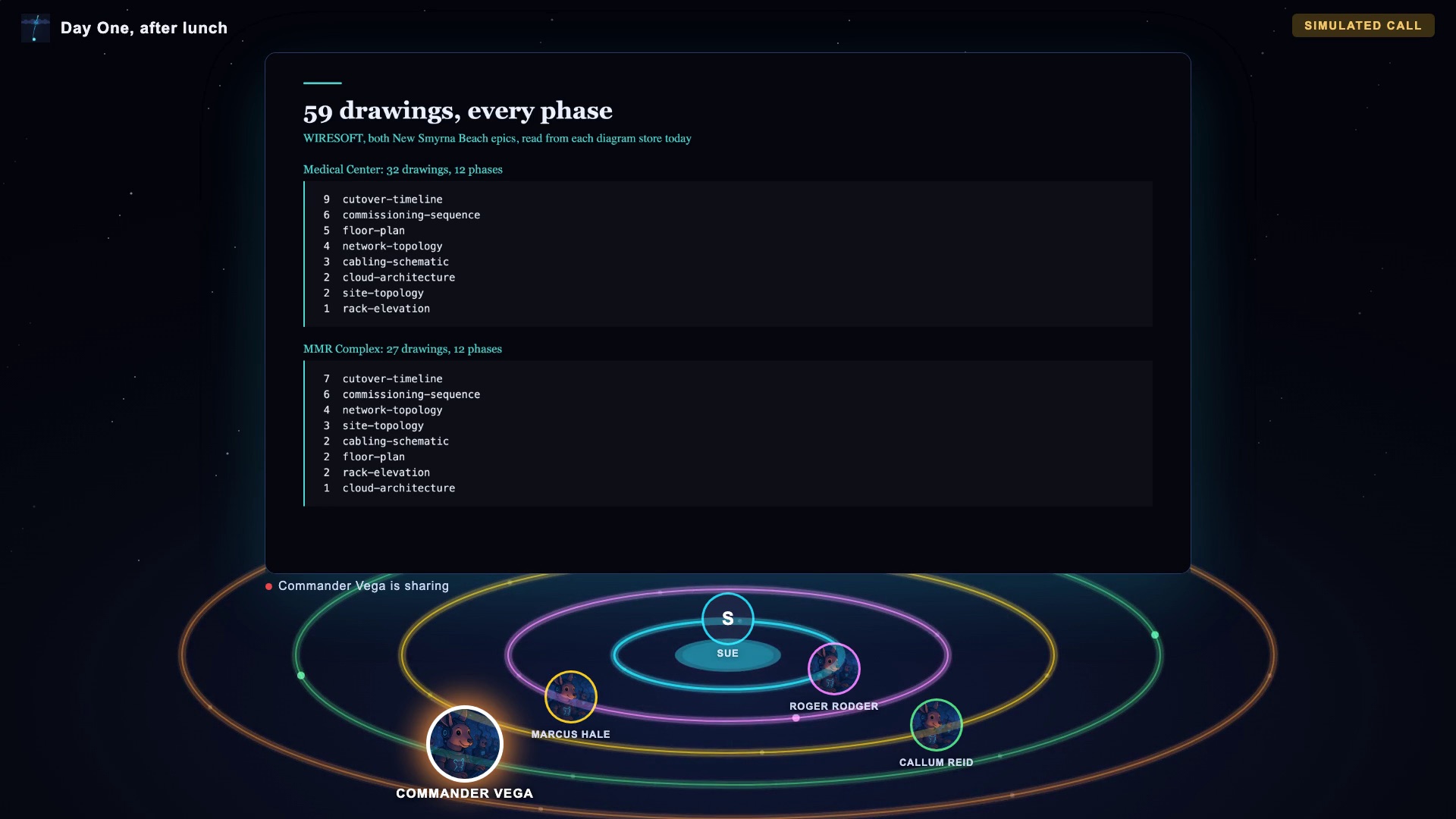
The call is not a grid of faces. It is StellarView’s five rings, the same ones that draw a codebase by layer, tipped back so you look down into them like a coliseum. Sue sits at the centre. The Commanders sit on the rings. Whoever is speaking lights up.
It started as a joke about a better meeting view. It stayed because it says what the meeting is: people and agents at different distances from the same centre.
Check in by division
Sue asks each division for one thing. They answer from their own records.
- Enterprise. QMG runs on 43 wiki pages in its own Confluence space. Cicero’s Constellation finished, and its backend is deployed in our account: 22 functions, 46 tables.
- Vertical SaaS. Coastal Critters is live, with a report after every visit. OutlawCounsel is live for small law firms. Same factory, different trade.
- Consumer. Youvocate is live, and a person’s case stays on their own device.
- Web content. The journal, the docs and the films come from the same record.
Then Commander Vega, on the hospital data center at New Smyrna Beach. Sue asks how the mission is proceeding. Vega answers plainly: every drawing is made, 59 across the two epics, every phase. Three of twelve phases have them posted. None are behind a password yet. That is the next job.
We kept that answer in because it is the answer. A standup that only reports what went well is a performance.
What the new Commander found
Roger shares his screen. That morning he found the Aqueduct epics: one requirements document in, and out came 10 phases, 106 work units, sized at 848 hours. The phase branches were built overnight.
Marcus takes him to the deepest gap in it. The application’s database role could not bypass row-level security, and the plan needed it not to. The answer was two connection strings: a restricted role for the app, the owner for migrations. It became its own work unit, WU-1-4, and it shipped in one commit with the migration, the role and both strings.
From a question in a document to a commit you can open. Roger asks the room whether anyone else is doing that.
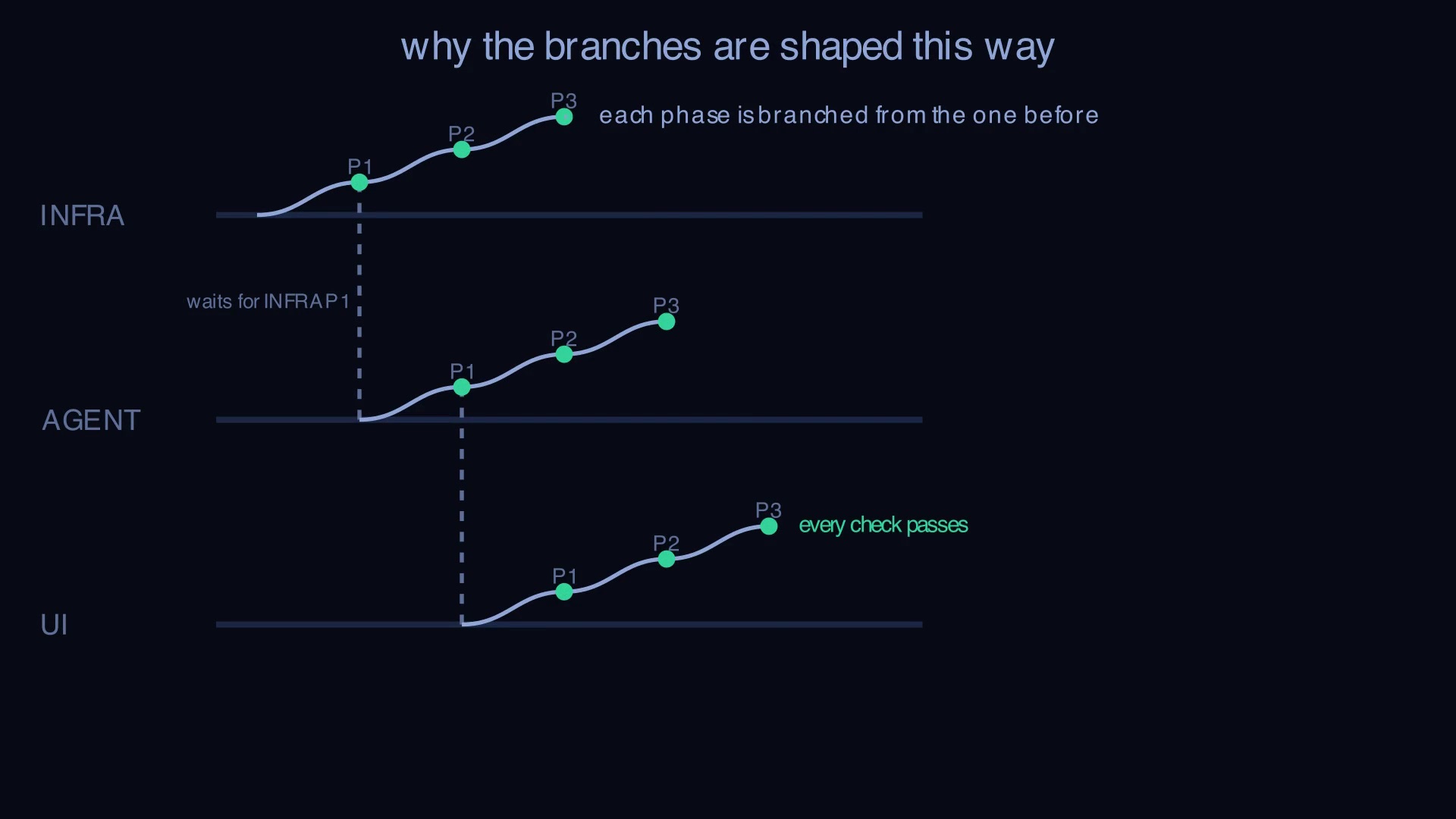
Callum answers the obvious next question, why the branches look like a staircase, with a Flyby: a short drawn film of a process that is on no single screen. Each phase is branched from the one before, and a phase in one repository waits for the phase it depends on in another. A Flyby draws the idea. It never pretends to be the product.
Then the parts a new person needs: how StellarView runs on a laptop in Docker and in a customer’s own account without anyone moving their data, how the Slingshot client is built, and what a migration takes when a client’s database lives on a box under a desk.
How the film was made
StellarView wrote the film’s request. It read the screens it had captured that day, refused any it could not account for, checked every voice against the house rules, and asked the Snapper, our film studio, whether it could render it before sending it.
The Snapper rendered it and wrote a model underneath, which we call the World. For this film it holds 223 topics: 211 written out, 12 left to open on demand. It drew on 68 sources that StellarView supplied: the glossary, the docs, the short films that define each term, and the repository and tracker behind the work. Every topic cites where it came from; none were dropped for lack of a source.
It took 61 model calls. They ran on a Claude subscription, so there was no per-call bill. The tool’s own estimate of the same work at API prices was $6.65. That is an estimate, not a charge.
Then StellarView checked the result, and the checks earned their keep:
- A figure that was legible on its own screen became unreadable once shrunk onto the call. The number gate caught it. The fix was a tighter capture.
- An early cut played a licensed track at the end with no credit. Caught, credited, re-cut.
- Three screens carried other people’s email addresses and a partner’s IP addresses. The pixel scan found them; they are blurred, and the record of each screen says so.
None of that is a reason to trust the film. It is the reason you can check it.
Credits
Voices: Sue (LJ Speech, public domain). Roger Rodger and Callum Reid (CSTR VCTK Corpus, University of Edinburgh, CC BY 4.0). Marcus Hale (en_US joe, CC0). Commander Vega (Bryce Beattie, public domain). All spoken by piper.
Music: “Volatile Reaction” and “Movement Proposition”, Kevin MacLeod (incompetech.com), Licensed under Creative Commons: By Attribution 3.0 License, http://creativecommons.org/licenses/by/3.0/
Roger Rodger, Marcus Hale, Callum Reid and Commander Vega are roles, not people.